


The Weight of Longing
- Feb 10
- 4 min read

A family drama unfolds as siblings travel to Goa to spend Christmas with their estranged aunt after their mother’s death. They leave Mumbai feeling “happiness is past, only sadness waits in future…We are empty houses waiting for someone to open the door”.
By Meher Pestonji in Mumbai
When a film set in Goa has no stereotypical visuals – beach, palm trees, tourists – the filmmaker is playing with ideas, not images. The slow development of characters through mellow voice, subtle body language, and the interplay of light and shadow create a poetic canvas with a muted colour palette that leaves you musing long after the screen has turned blank.
Its no surprise that Omkar Bhatkar’s The Weight of Longing (Iktsuarpok) received the Special Jury Award for Best Debut Director at the recently concluded 22nd Third Eye Asian Film Festival in Mumbai. Omkar branches out into a new genre of filmmaking placing spoken word poetry centre-stage in a nuanced dialogue as his characters confront loss and reflection, friendship and solitude.
A family drama unfolds as siblings travel to Goa to spend Christmas with their estranged aunt after their mother’s death. They leave Mumbai feeling “happiness is past, only sadness waits in future…We are empty houses waiting for someone to open the door”.

Awkward initial greetings give way to tentative camaraderie as the trajectories of separate lives pull in different directions. Memories hold them together.
Memories of the past making memories for the future. It’s the coming together of a family that might not have happened without the mother’s death.
The film has been in the pipeline since 2021 when Iktsuarpok was staged as a play and one of the actors suggested making it into a film. Over four years he managed to raise finance and the film was shot in eleven days with the entire crew working on a shoe-string budget.
In Mumbai, Omkar is known for intimate philosophical theatre with music, movement and lighting creating a mesmerising ambiance. It’s interesting to see him evolve into filmmaking, a more challenging medium.
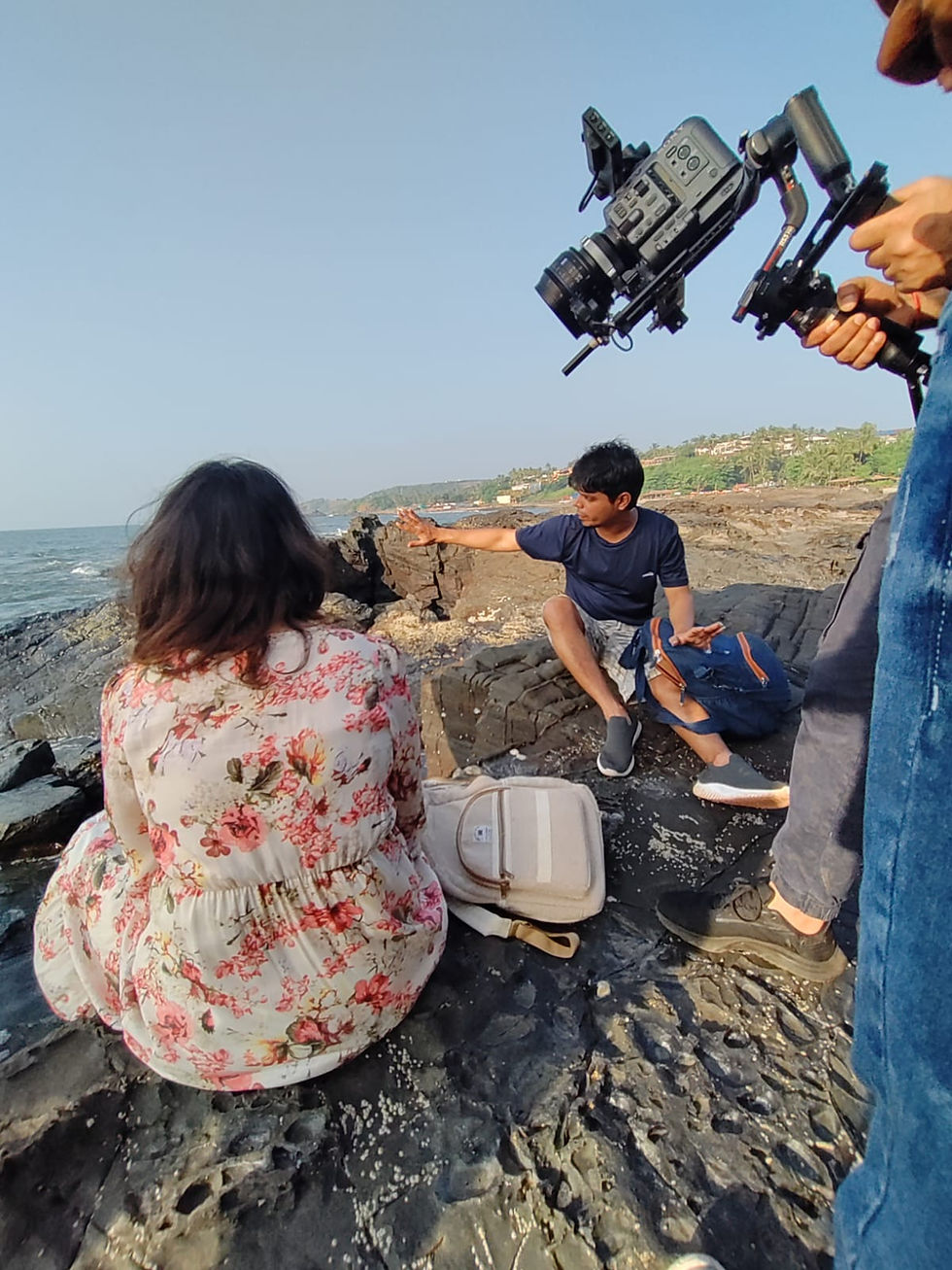
What inspired you to get into filmmaking? Which filmmakers do you admire? Which Indian filmmaker would you like to be compared to?
I have never viewed my identity as an artist through the lens of a single medium. I see myself as a multidisciplinary creator—whether I am writing plays, painting, or translating the rhythm of poetry into theatrical renditions, the core impulse remains the same. My entry into filmmaking wasn't a departure, but an expansion.
Filmmaking is a demanding, expensive art compared to the relative leanness of theatre. I have many scripts waiting in the wings, but I refuse to spend my creative energy hunting for capital. I prefer to let the work draw the right people in—much like my producer, Akshay Jha, found me. Iktsuarpok was born from that serendipity: a shoe-string budget fuelled by a massive, collective passion.

Regarding my influences, my journey has been shaped by masters of ‘slow cinema’ who prioritize atmosphere over plot: Andrei Tarkovsky, Ingmar Bergman, Yasujirō Ozu, Terrence Malick, Nuri Bilge Ceylan, and Christophe Honoré.
In the Indian context, I don’t seek comparison, but I find deep resonance in the works of Rituparno Ghosh and Aparna Sen.
While in the discussion after the screening, Chitra Palekar mentioned Mani Kaul—and I certainly respect his formal experimentation—I believe every filmmaker eventually carves out a solitary path.

Is this a new genre you are creating? Are there other films using poetry in this manner?
I wouldn't call it a genre yet, but rather an existential poetry on screen. This film intentionally fractures the conventional ‘grammar’ of cinema. We’ve discarded the traditional rules of screenwriting and camera movement to allow the verse to dictate the visual flow.
It is rare to find cinema where poetry is the marrow rather than just an ornament. Aside from Jim Jarmusch’s Paterson, which utilizes the audio and text of poetry beautifully, I haven't encountered many films that commit to this degree of poetic immersion. We are pushing the medium to see if it can hold the weight of a poem without breaking.

Describe the transition from theatre to cinema.
I don’t experience it as a transition, but as a shift in scale and economics. I write for the screen, the stage, and the page simultaneously. The novel is the most intimate and economically free; theatre requires more; and cinema is the most taxing.
The primary difference for me lies in longevity. Theatre is inherently ephemeral—a beautiful, fleeting breath that vanishes once the curtain falls.
Cinema, however, is preserved art. It offers a permanence that theatre cannot. I currently have a Marathi film scripted and ready; I am simply waiting for a collaborator who is willing to embark on that specific journey. I love the ‘now’ of the stage, but I am deeply moved by the ‘forever’ of the film.

You use untranslatable words like ‘Meraki’ and ‘Susegad’. What is the point you are making? Is the audience ready for this?
The core of Iktsuarpok is an exploration of the beauty of the untranslatable. Every culture possesses a unique vocabulary for the soul’s most specific tremors—feelings that the English language, for all its utility, simply cannot capture. By juxtaposing a Greek concept like Meraki with a Goan one like Susegad, I am highlighting a universal human experience that transcends geography.

As for the audience, I never create with their capacity or palatability in mind. I believe that the moment an artist begins to gauge the audience's readiness, they sacrifice their authenticity. Art should not be a compromise.
Whether in theatre or film, I create what is true to the vision; it is the audience’s job to rise to meet the work, not the work’s job to simplify itself for the audience.
Meher Pestonji is a writer, poet and social activist based in Mumbai. She has been a journalist writing on multiple social issues, theatre, literature and art, and she has worked in several grassroots and civil society campaigns for the rights of the marginalised, for women’s rights, housing rights of slum dwellers, with street kids, among other campaigns. Her books include Mixed Marriage and Other Parsi Stories, Pervez, Sadak Chhaap, Piano for sale, Feeding crows, Outsider. Her other books include Being Human in a War Zone, Can Poetry Halt War, Offspring and Poems.
Photos courtesy Omkar Bhatkar.