


Six yards of elegance and grace: A love letter to saree
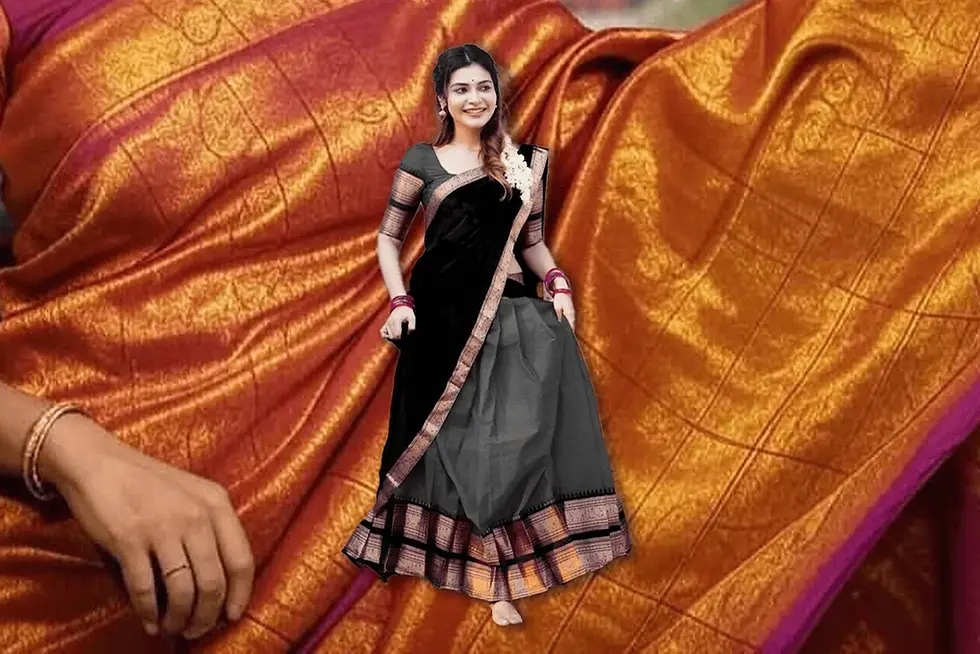
Six yards of it. Draped, tucked, sometimes pinned with quiet authority. A pallu thrown over a shoulder with the casual elegance of someone who has never once thought about how elegant they look.
By Ganpy Nataraj
If you asked me to close my eyes and describe the women who raised me — the first thing I would see — before their faces, before their voices fully form — is fabric.
Six yards of it.
Draped, tucked, sometimes pinned with quiet authority. A pallu thrown over a shoulder with the casual elegance of someone who has never once thought about how elegant they look.
I grew up Tamil, which means I grew up surrounded by sarees the way some children grow up surrounded by snow — it was simply the weather. My Paattis wore them. My Athais, my Periyammas, my Chitthis wore them. My Amma wore them to temple, to weddings, to the vegetable market on Tuesday mornings, and occasionally, unforgettably, while scolding me at considerable volume.
There was no occasion the saree was not equal to.
And then there were the girls. My cousins and their friends. The teenage girls in the neighborhood and the young women in their half-sarees — that particular Tamil rite of passage, that elegant in-between, not quite a child’s paavaadai, not yet a woman’s full six yards. A half-saree is a girl learning a language she will speak for the rest of her life. I didn’t know that then. I just knew it looked like something important was happening.
I was a boy on the periphery of all of this. Watching. Absorbing. Filing it away in some part of my brain I didn’t have a name for yet. This piece is me, finally, finding the name.
Every Tamil wedding I attended as a child smelled like jasmine and sounded like silk.
That particular sound — the rustle of a Kanjivaram as a woman crosses a room, the soft percussion of it against the floor — is one of those sounds that lives below memory, in the body. I couldn’t have named it then. I was seven, or ten, or twelve, sitting cross-legged somewhere I wasn’t supposed to be, watching the women of my family move through a wedding hall with a composure I found quietly baffling. How does anyone carry that much fabric and still look like they’re doing nothing at all?

At those same weddings I was dressed in a small, stiff shirt and trousers that someone had ironed with great ambition. Later, a silk dhoti — something I’ll have more to say about in Part II. But the saree was never mine to wear. Only mine to witness.
Which, it turns out, was its own education.
This is the piece I’ve been meaning to write for thirty years. About the garment that clothed every woman I have ever loved. About its four-thousand-year history, its regional obsessions, its caste politics, its breathtaking variety. About the weavers who make it and the system that exploits them. About silk, and what silk actually costs — and I don’t mean the price tag.
About why a boy who grew up on the outside of all of this still can’t stop thinking about it.
What Even Is a Saree?
Before anything else — before the history, the politics, the silk and what silk costs — there is the question of what a saree actually is. The answer is deceptively simple.One thing before we go further: is it sari or saree? I prefer saree. Don’t ask me why.
A saree is a single rectangular piece of unstitched cloth. Anywhere between five and nine yards long, roughly four feet wide. No buttons. No zippers. No cuts, no seams, no instructions included. You take this rectangle and you make it work — around your body, over your shoulder, across your chest — through a system of folds and tucks and a single safety pin if you’re being cautious, or no safety pin at all if you’re the kind of woman my Paati was.
That’s it. That’s the whole garment.
And somehow, this rectangle has clothed the subcontinent for over four thousand years.
There is something almost philosophical about the saree’s refusal to be cut. While the rest of the world’s clothing traditions evolved toward tailoring — toward measuring and cutting fabric to fit the body — the Indian textile tradition held firm to the idea of the unstitched garment.
The body adapts to the cloth. The cloth is not sacrificed for the body. For centuries, stitching was associated with foreign influence, with the ‘mleccha’ — the outsider — and the uncut garment carried connotations of ritual purity that a sewn one could not. You wore unstitched cloth to temple. You wore it for prayer. You wore it because the needle had not violated it.
There is an entire theology hiding inside a saree’s hem.

Glossary
Paatti — grandmother. Athai — paternal aunt. Periyamma — mother’s elder sister. Chitthi — mother’s younger sister. Amma — mother. Akka — elder sister.
Pallu — the decorative end of the saree, typically draped over the shoulder. Paavaadai — a long skirt worn by young Tamil girls.
Mleccha — a Sanskrit term for foreigner or outsider. Zari — gold or silver thread woven into fabric.
Co-Optex — the Tamil Nadu Handloom Weavers’ Cooperative Society, established 1935. GI tag — Geographical Indication, a certification protecting regional products.
Ganpy Nataraj is an entrepreneur, author of “TEXIT – A Star Alone” (thriller) and short stories. He is a moody writer writing “stuff” — Politics, Movies, Music, Sports, Satire, Food, etc.
Top images: Courtesy icytales.com and belegendcollection.in
Editor's note: Celebrating the saree. This is Part I of a series on saree.
Courtesy americankahani.com