


Worming
Updated: May 6

"Until the lions have their own historians, the history of the hunt will always glorify the hunter." - Chinua Achebe
By Aayushi Rana
That is how they spelled it.
The threatening notes , slipped under the door of a school for girls, placed in the corners of a hospital full of the sick and the dying, in 1896 Bombay. Warning. Spelt worming. The Native Society, anonymous, invisible, full of bile.
That detail is from a novel, not from the two books under review here. But reading Margins to Centre Stage by Archana Kaushik and Shruti Nagvanshi, and Dalits in Independent India by Lenin Raghuvanshi, I kept returning to it. Because the misspelling has not stopped. It has only changed address.
The SC/ST Prevention of Atrocities Act. It exists. It has existed since 1989. And yet, in Uttar Pradesh, the state that accounts for more than 58 per cent of human rights complaints filed with the National Human Rights Commission, police officers routinely classify crimes against Dalits under ordinary provisions. Code offences. Not the Act. Not the specific law written for these specific crimes, these people, this history.
Warning becomes worming. The law becomes its own erasure.
Raghuvanshi calls this a State of Impunity. He means it clinically, not rhetorically. He means: this is not negligence. This is design.

Lenin Raghuvanshi’s Dalits in Independent India acts as a stern indictment of the Indian state’s post-colonial journey. Raghuvanshi introduces a chilling concept: the "State of Impunity." He argues with journalistic precision that while India shed its British shackles in 1947, it failed to dismantle the domestic architecture of oppression, the caste system.
His writing is particularly sharp when dissecting the "Police Raj." He illustrates how law enforcement, rather than acting as a shield for the vulnerable, often functions as the enforcement arm of the landed, upper-caste elite. By documenting cases where entire communities are punished for the alleged "deviance" of one individual, he exposes a systemic bias where justice is not blind, but acutely aware of one's lineage. His tone is one of urgent advocacy, reminding the reader that for a Dalit, the "cradle to grave" journey is often a gauntlet of "sham encounters" and "illegal detentions."
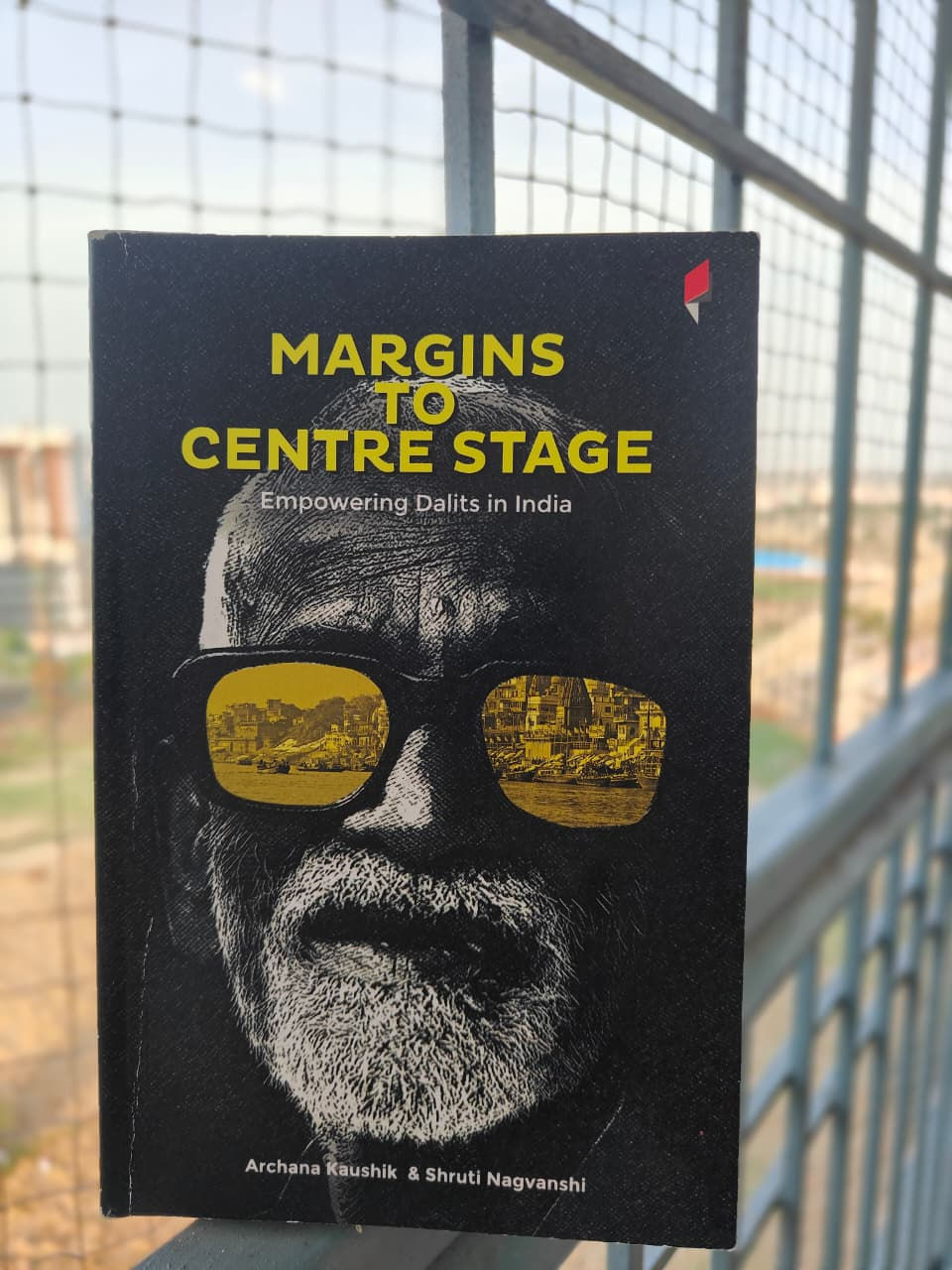
While Raghuvanshi provides the structural critique, Margins to Centre Stage by Kaushik and Nagvanshi offers the ethnographic heartbeat of this struggle. This work moves away from the abstract halls of policy and into the dusty lanes of Varanasi and the weaving sheds of the Mushar community.

The authors employ a "Praxis to Practice" framework, showing how theoretical empowerment is translated into "Bal Panchayats" (Children’s Councils) and "Folk Schools." The narrative shift from victims to "change agents" is the book's greatest strength. We see the Mushar community of Belwa village, historically relegated to the periphery, fighting not just for political representation, but for the basic biological right to survive hunger and disease. The transition of these communities from "being led" to "leading" is documented with a sensitivity that avoids the trap of "poverty tourism," focusing instead on the agency of the oppressed.
One of the most moving intersections of these two books is their treatment of the laboring classes. Margins to Centre Stage captures the "yarns of hardship" within the Banarasi sari industry. It reveals the cruel irony that those who weave the most exquisite symbols of Indian heritage often live in abject poverty, battling tuberculosis and debt bondage.
Raghuvanshi complements this by detailing the "newer forms of labor bondage" that govern 10 percent of India’s workforce. He argues that the caste system is the primary fuel for this engine of exploitation. Both books successfully humanize the statistics of the National Rural Employment Guarantee Act (NREGA), showing that without social auditing and grassroots vigilance, even the most well-intentioned state schemes are swallowed by the "unyielding grip of impunity."
While both works are indispensable for anyone seeking to understand modern India, they are not without their stylistic hurdles. Raghuvanshi’s Dalits in Independent India occasionally leans heavily on academic jargon and repetitive terminologies that may distance the casual reader. His intensity is palpable, but the density of the "State of Impunity" framework can sometimes overshadow the individual human stories that drive the movement.
Conversely, Margins to Centre Stage at times adopts a tone that feels slightly celebratory or "NGO-centric." While the successes of the PVCHR (People's Vigilance Committee on Human Rights) are undeniably impressive, the writing occasionally risks smoothing over the internal frictions and immense psychological toll that such long-term social action takes on the activists themselves.
I keep returning to a detail from the prologue of Margins to Centre Stage. The authors explain that throughout the book, the change agents, the activists, the organisers, the people who did the actual work, are referred to as ‘WE,’ not as PVCHR. The reason given is that the book is not about promoting an organisation. It is about honouring the hundreds of people who gave years of their lives to this work without recognition.

These books will not make you feel better about India.
They are not written to do that.
What they do is make it harder not to know. And in a country that has built, over the years, a sophisticated infrastructure of not-knowing, of translating atrocity into abstraction, of looking away with grace and efficiency, that is nothing.
The Bal Panchayat children are still there. Still speaking.
Whether anyone outside those villages is listening, that question, both books leave deliberately open.
As they should.
Books reviewed:
Margins to Centre Stage: Empowering Dalits in India Archana Kaushik and Shruti Nagvanshi
ASIN : 9381043191
Publisher : Frontpage Pub.
ISBN-10 : 9789381043196
Dalits in Independent India Lenin Raghuvanshi Publisher : Frontpage Pub.ISBN-10 : 978938103608