


When Subhas Chandra Bose hailed Mahatma Gandhi

"His name will be written in letters of gold in our national history for all time.”
By Raju Mansukhani
During January every year, there are commemorations galore: the birth anniversary of Netaji Subhas Chandra Bose on 23rd January is followed by the solemn anniversary of Mahatma Gandhi’s assassination on 30th January. Adding to historic events are political milestones, landmark dates of 26th January, giving every patriotic Indian opportunity to hail iconic leaders of our freedom struggle.
It is equally humbling and inspiring to read the speeches of Netaji Subhas Chandra Bose when he paid tributes to Mahatma Gandhi on his birthday, 2nd October. The year was 1943. Netaji’s adventurous escape from British detention, and his appearance in Germany, was avidly followed in India.
In a broadcast from Bangkok, Netaji said, "this day Indians all over the world are celebrating the 75th birth anniversary of their greatest leader, Mahatma Gandhi. It is customary on such an occasion to relate the life-experience of the man whom we honour and to whom we pay our homage of love and respect...I shall devote myself to an estimation of the place of Mahatmaji in the history of India's struggle for independence.” Netaji emphasized that Mahatma Gandhi’s service to the cause of India's freedom is so unique and unparalleled that “his name will be written in letters of gold in our national history for all time”.
In the broadcast, Netaji provided a bird's eye-view of the British conquest of India, the political enslavement and economic exploitation which followed, millions who died of hunger, starvation in India while in Britain, the country's wealth grew exponentially. He took listeners through the 1857 revolt and onto the formation of the Indian National Congress in 1885.
He said, “The leaders of the Congress were at first afraid of demanding complete independence and the severance of the British connection. Within a span of twenty years, however, new life was infused into the Congress. By 1905, we find leaders like Aurobindo Ghosh demanding complete independence of India. Along with this demand of complete independence, more extreme methods were adopted for achieving liberty. In Bengal, the boycott of British goods was adopted as a retaliation against the partition of that province, and this method of boycott was gradually taken up all over India. Not content with economic boycott, Indian youths next took to the cult of the bomb and the revolver.”
Netaji explained how the British government, during and after the last World War, duped the Indian leaders, made false promises and used India’s men and resources to ‘strengthen the chains of Indian bondage’. In 1919 the Rowlatt Act and Jallianwala Bagh massacre were the two ‘rewards for all the sacrifices made by the Indian people during the last World War’.
The Indian people were “stunned and paralysed for the time being. All attempts for achieving liberty had been ruthlessly crushed by the British and their armed forces. Constitutional agitation, boycott of British goods, armed revolution - all had failed alike to bring freedom. There was not a ray of hope left and the Indian people, though their hearts were burning with indignation, were groping in the dark for a new method and a new weapon of struggle. Just at this psychological moment, Mahatma Gandhi appeared on the scene with his novel method of Non-Cooperation and Satyagraha or Civil Disobedience. It appeared as if he had been sent by Providence to show the path to liberty. Immediately and spontaneously, the entire nation rallied round his banner. Every Indian's face was now lit up with hope and confidence. Ultimate victory was once again assured,” he said.
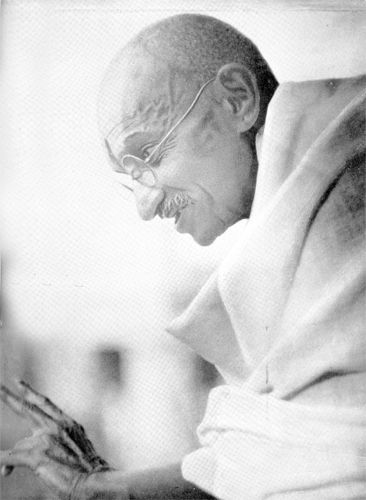
Netaji said, “For twenty years and more Mahatma Gandhi has worked for India's salvation, and with him the Indian people too have worked. It is no exaggeration to say that if in 1920 he had not come forward with his weapon of struggle, India would today perhaps have still been prostrate.”
In the broadcast Netaji focused on what the Indian people have learnt from Mahatma Gandhi which are “indispensable preconditions for the attainment of independence. They have, first of all, learnt national self-respect and self-confidence as a result of which revolutionary fervour is now blazing in their hearts. Secondly, they have now got a countrywide organisation which reaches the remotest villages of India. Now that the message of liberty has permeated the hearts of all Indians and they have got a countrywide political organisation representing the whole nation, the stage is set for the final struggle for liberty, the last war of independence.” To those stirring words, we can add: Jai Netaji ! Jai Hind!
Raju Manusukhani is a senior journalist and researcher.
Photo-credit: www.mkgandhi.org