


What was that ‘something else?’
- Jan 12
- 4 min read

No one in our Parsi family was aware of the meditative quality of Mandalas. We had no idea they were ritual symbols representing the Universe in Hinduism and Buddhism, or that they are ‘powerful symbols to help embark on a spiritual journey of self-discovery’.
By Meher Pestonji in Mumbai
I first heard the word Mandala from celebrated painter Akbar Padamsee – but he was not talking about art. He was referring to his group of close friends -- filmmakers Mani Kaul, Kumar Shahani, psychoanalyst Udayan Patel, industrialist Bhaichand Patel and a couple of others. All erudite intellectuals from diverse fields.
What was the mandala they formed, I wondered. Were they connected by similar ideals? Was it a shared vision about art? Was it being on the same elevated plane of thought?
“Its all that and more,” said Akbar, reluctant to elaborate.
The Mandala word came up again during a joint interview with Akbar and Kumar Shahani. We were comparing different ways of art practice, a painter working alone in his studio and a filmmaker working with a team.

Akbar was clear he could never paint among people.
“I have to be alone with canvas and paint. I am the first spectator of my work. If I am not surprised at what I see, the painting does not work, because I have been consciously engaging with it. Only when my conscious mind is quiet, something else takes over. A new dimension enters the work making it a success.”
What was that ‘something else?’ I wondered.
As a filmmaker Kumar can never work alone, but he too talks of a subtle ‘something else’ in the context of his work.
“The entire team has to function as one mind,” he said. “Every person on the set -- actor, director, cameraman, even the clapper boy and the camera trolley pusher -- has to be on the same wavelength. If even one person is out of sync we have to take the shot again and again.”
“They have to be in a mandala, connected by the same wave of energy,” explained Akbar.
Was the ‘something else’ a wave of energy, I wondered again, remembering our earlier
conversations.

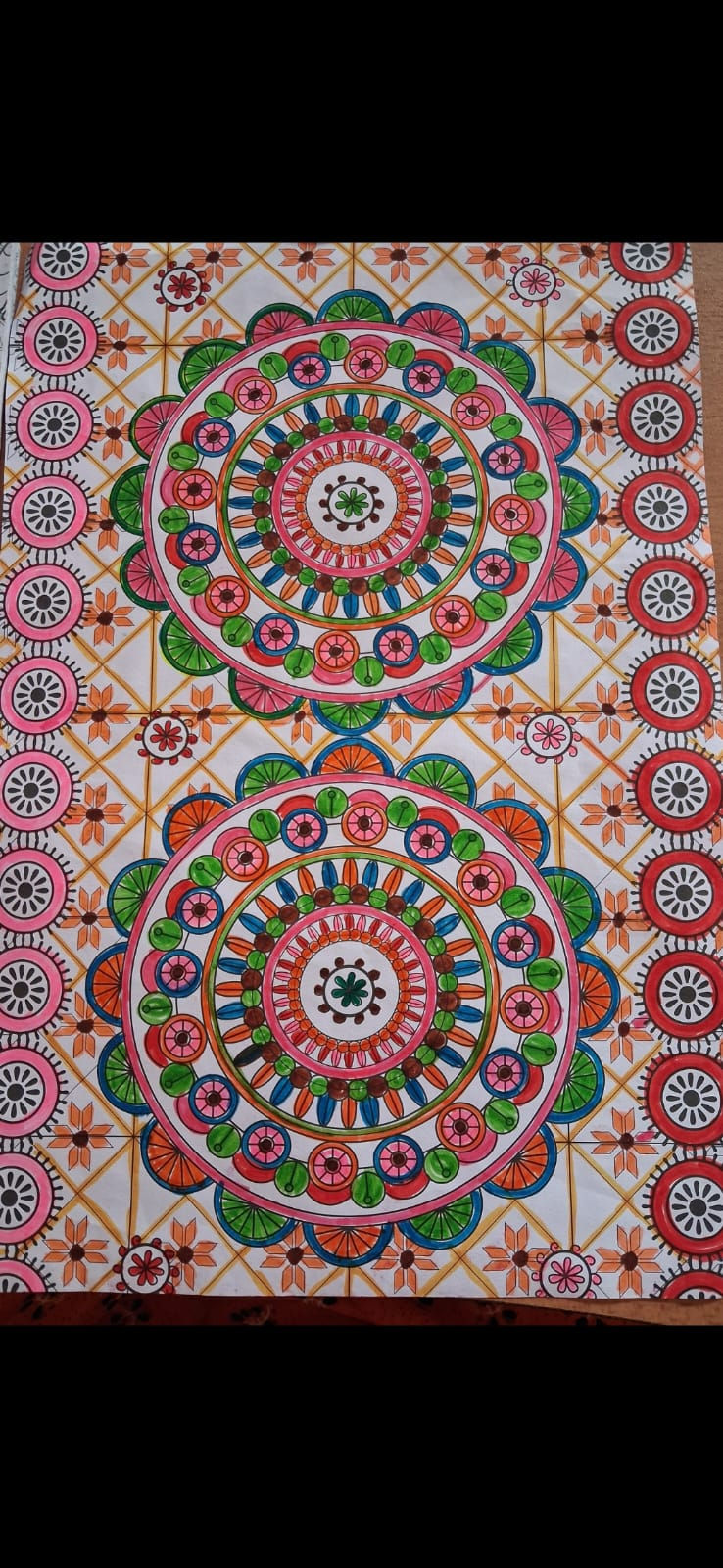
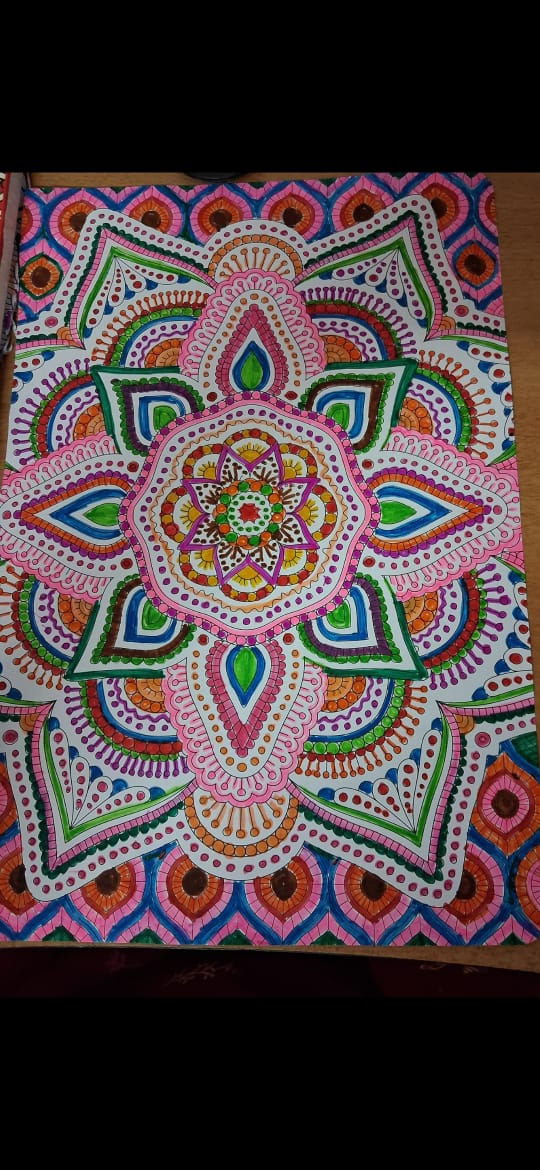
I recall this interview as my daughter wins accolades for her mandala drawings. She has come to them by accident, when a doctor recommended she take up a hobby. To de-stress, she picked up animation, colouring books which I thought too childish, and remembered adult colouring books I’d seen in a bookshop. That’s how Mandalas entered our home.
No one in our Parsi family was aware of the meditative quality of Mandalas. We had no idea they were ritual symbols representing the Universe in Hinduism and Buddhism, or that they are :powerful symbols to help embark on a spiritual journey of self-discovery”, as the back cover of a colouring book informed. Wikipedia describes them as a “spiritual guidance tool for establishing sacred space”.
Research led me to discover that the word Mandala first appears in the Rigveda. In Sanskrit it refers to a circle, a sacred geometry, creating a balanced mind. Mandalas often take the form of a flower encased in a circle or incorporate the circle within a square. Contemporary rangoli designs have roots in Mandalas.

Originally made by Tibetan Buddhist monks as symbols of purification on their journey towards enlightenment, Mandalas were constructed with sand and coloured rice, while the monks meditated. After four days they were ritually dismantled and the rice/sand spilled into running water to spread blessings wherever the water took it.
How does this connect with Akbar’s understanding of Mandala and its subtle energies, I wondered? And how does one explain the way my daughter, a Sai Baba and Mother Mary devotee, was introduced to Mandalas?
Did some mystical flow of energy connect the doctor to my daughter and further to Mandalas?

She does not create mandalas but adds colour into delicate printed outlines. “The intricate lines require body-mind-spirit coordination. Intense concentration gets absorbed into the act of painting as in Zen meditation,” commented a friend.
My daughter is unaware she is into Zen meditation, but the practice of colouring Mandalas has relaxed her, gifted feel-good moments, and reduced her intake of sleeping tablets. But there is still no logical explanation of how they entered her life.
With our current scientific mindset any phenomenon that does not fit neat, logical explanations, is written off as coincidence. However, creative people are open to contemplating realms beyond the rational. Open to accepting mystical connections without proof, in creative work as also with life.

I am reminded of a book I read more than thirty years ago. Boiling Energy: Community Healing among the Kalahari Kung by Richard Katz, an anthropologist at Harvard University, who spent months studying the healing rituals of tribals in the Kalahari desert.
The whole village danced during a certain phase of the moon when the shaman went into a trance and ‘num’, an energy residing at the base of the spine, came to a boil releasing healing power. When he was high on ‘num’ the shaman could heal the sick and even tell the sex of a new born child in a distant village.
Professor Katz documented this energy exchange that produced results, but had no quantifiable method of being measured.
Mandalas and num are ancient concepts in diverse cultures on different continents. Both harnessing energy in non-material ways.
Sets me wondering…
With the emphasis on materialism and rational thinking, have humans de-valued, perhaps lost, subtle but powerful energy connections?
Meher Pestonji is a writer, poet and social activist based in Mumbai. She has been a journalist writing on multiple social issues, theatre, literature and art, and she has worked in several grassroots and civil society campaigns for the rights of the marginalised, for women’s rights, housing rights of slum dwellers, with street kids, among other campaigns. Her books include Mixed Marriage and Other Parsi Stories, Pervez, Sadak Chhaap, Piano for sale, Feeding crows, Outsider. Her other books include Being Human in a War Zone, Can Poetry Halt War, Offspring and Poems.