


This generation does not see fun and resistance as opposites

When our children grow up and ask, “What were you doing while the fascists were dismantling our country?” We will have an answer. We were out there, resisting.
By Divya Trivedi in Delhi
After a long time, people in the capital, and indeed in many parts of India, breathed in an air replete with something they had forgotten existed: hope. Two very unlikely forces came together to make this happen: an immigrant Dalit student from Boston, Abhijeet Dipke, and Gen Z. Originally from Maharashtra, when Dipke first made his appearance, many questioned his locus standi and motivation. But as the protest organised by the Cockroach Janata Party gained momentum and ultimately fulfilled its stated agenda, the criticisms levelled against him became harder to sustain.
Gen Z, on the other hand, the collective that comes after Millennials, has redefined itself beyond all doubt. For years, many were dismissive of them as they seemed little interested in anything other than Social Media. Considered politically shallow, they seemed too distracted, too online, too frivolous, too consumed by trends to sustain conviction. However, watching them occupy the streets, challenge an authoritarian regime, and refuse to back down has made everybody incredibly proud.
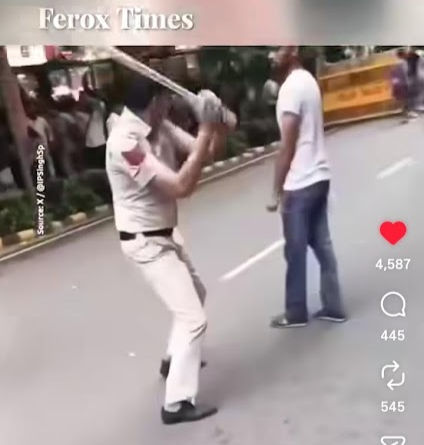
After the Delhi Police and the Rapid Action Force’s violent crackdown on peaceful protesters at Jantar Mantar and Central Delhi on July 20, the movement demanding the resignation of Education Minister Dharmendra Pradhan did not dissipate. It swelled.
More people came. I was determined to be one of them, despite having an 11-month-old baby. I headed to the vibrant protest site with youngsters (and some elders) thronging the place.
The air in and around Jantar Mantar crackled like electricity for many days. People streamed in from every direction. Students with back-packs, office-goers still in work clothes, elderly couples, families with children, first-time protesters, seasoned activists. Witty, hilarious posters dotted the skyline, driving their point home with precision.
On the fringes, the police stood in full protective gear, an intimidating wall of helmets, shields and batons. But the crowd was no longer afraid.
For the first time in years, there was a protest that absorbed the State’s attempt to crush it and simply kept growing. When one stage was taken down, another emerged. The crowd did not scatter. It reorganised.
All major protests over the past decade, be it the farmers’ movement, the anti-CAA demonstrations, or countless other mobilisations – the State tried to crush them. They tried to break this one too, but it couldn’t. Though the protest spread all over the country, people from other states came to participate at Jantar Mantar.
There was romanticism at the protest site, but there was also healthy scepticism. After 12 years of repeatedly running into a stone wall, many were asking: Why was this protest allowed to flourish? Who was really behind it -- the RSS, Big Tech’s algorithm, or Modi himself, keen to project to an international audience that India remains a democracy where people are free to dissent?
There have been doubts about the movement among some. And critical questions around the leadership. However, what is undoubtedly clear is this: the youngsters at the protest were genuine. Moments like this cease to be shaped by who organises it.
It became about those who chose to show up. The people at the protest were not there because it was fashionable. They knew the risks. They had watched the crackdown. They came anyway.
At Jantar Mantar, there was determination, but there was also ‘fun’. Friends posed for photographs with placards before returning to slogans. Volunteers moved through the crowd distributing water, snacks, clothes and, astonishingly, pizzas and burgers, provided by Samaritans and supporters from Delhi, and all over the world.
It was the first demonstration I ever attended where volunteers handed out free pizzas and burgers. To my generation, that almost feels absurd, as if a protest must always look serious, and stoic. But perhaps that assumption belongs to us, not to them.
We have inherited a particular image of resistance: solemn faces, exhausted bodies, sacrifice worn almost as proof of sincerity. For Gen Z, fun does not weaken political commitment. It sustains it.
This generation does not see fun and resistance as opposites.
They can document history on Instagram -- while making it – and chant slogans between recording videos, eat burgers in protest, and still stand firm against power, and the might of the State. Of course, there is a class angle to all of this. But that analysis need not derail the reality unfolding before our eyes.
Every generation invents its own language of dissent. Every older generation mistakes it for frivolity.
Our job is not to tell the next generation how to fight and resist. It is to stand beside them. Or get out of the way.
Perhaps this is how a generation raised under constant surveillance and perpetual connectivity resists; they live it, perform it. What should matter is the refusal of ordinary people, who are frustrated with the system, to leave.
For years, hope has felt like an increasingly fragile emotion in India’s public life. Every major protest seemed destined to meet the same ending: a ban on protests, barricades, detentions, brute force, silence. At Jantar Mantar, for the first time in a long time, that script seems to be faltering.
Maybe only for a while. Maybe longer. But when our children grow up and ask, “What were you doing while the fascists were dismantling our country?” We will have an answer.
We were out there, resisting.

Divya Trivedi is a journalist who has worked with the Frontline and Hindu group for many years. She is based in Delhi.
Photos courtesy Instagram / Social Media