


The rise and rise of Ghost Newspapers: Fish Eye, Lake View, Bargi, Chinar, Bekhouf Shankh, Jumbo, Bhumi, Teesri Ankh, Teesri Duniya…
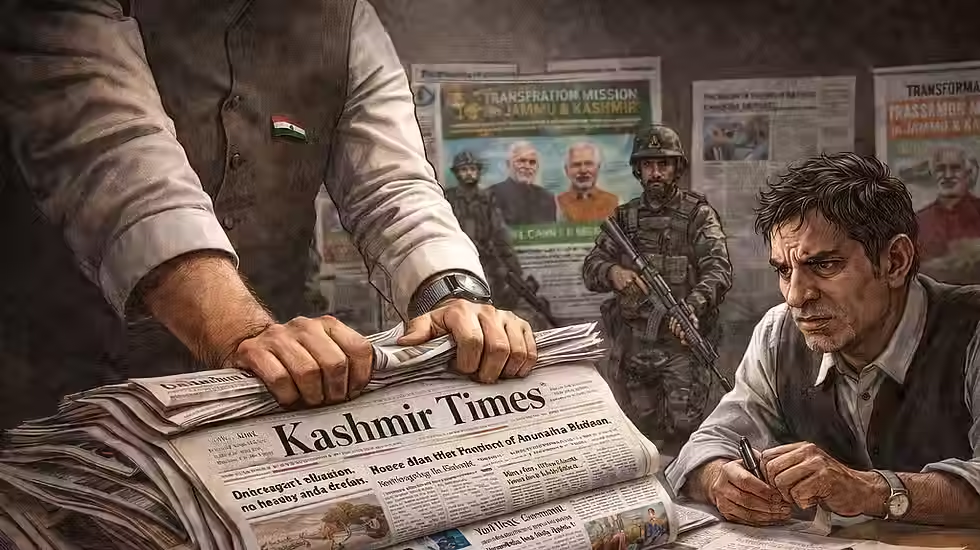
Not just a scam, it’s a symptom of an old, rotting system that helps the government launder advertisements for political loyalty through media outlets that have marginal or no presence. It helps the rulers to control independent media that refuses to succumb or compromise.
By Anuradha Bhasin
The list of newspapers that National Conference legislator Tanvir Sadiq recently read out in the state legislative assembly stirred laughter in the august house. It did sound comical.
Fish Eye, Lake View, Bargi, Chinar, Bekhouf Shankh, Jumbo, Bhumi, Teesri Ankh, Teesri Duniya…
These are the names of newspapers that, according to Sadiq, have been receiving disproportionate allocations of government advertising in Jammu and Kashmir. He says he has the evidence in black and white — a written reply from the Department of Information. And a quick reality check confirms what most people already know.
Many of these publications barely exist. In short, they are ghost publications receiving public money.
For all practical purposes they are vehicles for laundering advertisements into political loyalty.
Fish Eye has a website and an e-paper, which reads like the information department's own daily bulletin repurposed with a masthead. A Google search for Lake View is more likely to lead you to a monthly newspaper of the same name in Chicago or a hotel in Kashmir!
Bargi and Chinar do not appear to exist at all, though there is a listing for something called Barg-i-Chinar in the Registrar of Newspapers. The same for Jumbo Times, Teesri Duniya, and Pradesh Bhumi.

For most of the others, if they show up at all, they appear as Facebook pages and Instagram accounts posting videos of government programmes.
Absurd as it sounds, it is not surprising.
Background checks on editors
The 2020 Advertisement Policy of the Jammu and Kashmir government formally governs who gets government advertisements and who doesn't. On paper, it sounds rigorous. It mandates background checks on publishers, editors, and key staff before a newspaper is "empanelled" to make it eligible for government advertisements. It says no advertisements shall go to media outlets that "incite or intend to incite violence, question sovereignty and integrity of India or violate the accepted norms of public decency and behaviour."
The devil is in the detail. A newspaper can be disqualified for publishing content that "violates accepted norms of public decency and behaviour." Who decides what those norms are? The government? The very entity whose actions are being scrutinised and whose officials sign off on the advertisement releases.
In a functioning democracy, journalists investigate governments and hold them accountable. The idea that journalists must first pass a government vetting process before their newspaper can survive the loyalty test is the antithesis of democracy.
Valid outrage
Sadiq's outrage is valid. But he would do well to check how governments in Jammu and Kashmir and the rest of the country have used advertisements as a weapon – to reward or arm-twist newspapers into toeing the official line, or to use it as a formal, legalistic basis to punish newspapers the government disliked.
His own party was no exception. In 2017, during the PDP-BJP coalition government, the state empanelled 99 new newspapers in one stroke, taking the total empanelled publications to 467. Publications with unknown names like Zinda Sach, Truth Prevail, and Job Dot Com suddenly became public and were given bureaucratic cover. Many of them were not credible journalistic operations.
So, the rot in the system is not a BJP invention, nor a post-2019 invention. It is an old, bipartisan way of corruption. Every government in J&K has used advertising money as a lever to pull newspapers towards it or push independent ones away. The same instrument continues. Only the hand holding it has changed.
Yet, a lot has changed. Essentially, what changed after 2019 is also the scale and brazenness. When the state was stripped of statehood, downgraded to a Union Territory and placed under the direct authority of New Delhi and its appointed officials, the already-compromised media ecosystem became even more vulnerable.
The diversion of public advertising money to ghost newspapers has worsened dramatically during this period, as has the clampdown on the free press.
Those who pay the price
For years, the Kashmir Times stood largely alone in demanding that the distribution of advertisements be rationalised on a clear-cut criterion of circulation and credibility, rather than on the whims of whoever holds power. The newspaper’s own struggle to maintain independence came at a price.
In 2010, the Directorate of Advertising and Visual Publicity, which handles central government advertisements, abruptly stopped releasing advertisements to Kashmir Times without any explanation and warning. The paper was punished for being critical of the government's handling of the summer unrest and its pattern of human rights violations. It was never reversed.
In the decades before that, both the state and central government advertisements were often blocked for short or prolonged periods.
In 2019, after I moved the court against information curbs and the internet shutdown, the state government imposed a blanket advertisement ban on the newspaper.
Rather than surrender, we chose to shut all print editions, and, later, revive a skeletal digital operation which is primarily reader-supported. For us, surviving on principle was more important than government patronage.
This is what independent journalism comes to. It’s a choice between survival on the government's terms or survival despite them.
Meanwhile, as Tanvir Sadiq points out, publications that exist largely as social media pages posting government event videos are apparently receiving official advertisement support. This is ironic.
The Gatekeeping Directive
In October 2025, the Joint Director of Information in Jammu and Kashmir issued a directive to all District Information Officers, ostensibly aimed at combating "fake journalists" and misuse of media credentials. What it actually created is a comprehensive gatekeeping apparatus. Journalists must submit Aadhaar cards, PAN cards, salary statements for six months, appointment letters, and their full social media profiles for official "verification".
District Information Officers are now instructed to share press releases and official information only with journalists on "verified lists." Departments are told to refuse access or information to anyone who is not on the approved list.
Media houses are being pressed to publicly disassociate from journalists who attract official displeasure, even before any wrongdoing is proven.
The government, in effect, now decides who is a "bona fide" journalist. And those who are not on the list will not receive official information, cannot attend official briefings, and face the prospect of being reported to police for "credential misuse".
This was done purportedly to check ‘fake journalism’ on social media and to prevent ‘impostor journalists’ from resorting to blackmail and extortion. Indeed, that’s an undeniable and existing challenge. But look who they are rewarding.

The Fundamental Flaw
This brings us to the core problem: the government’s advertising policy, as it has existed, as a revenue model for the newspaper industry. Government advertising, which was originally conceived as a way to support the independent press and ensure the public's access to official information, has become the primary instrument for keeping the press in chains
Without a rationalised, rules-based, independently administered advertisement policy that is insulated from political interference, and where distribution is determined by verified circulation and credibility, government advertising will always be a weapon.
Newspapers in Jammu and Kashmir, as well as rest of the country, cannot survive on circulation revenue alone. Government advertisements are the primary source of income. A publication that loses government advertisements loses its ability to pay salaries, print editions, and keep it alive. This structural dependency was always exploited by governments, earlier in small measures, now more jarringly.
Tanvir Sadiq's demand for reform of the 2020 policy is spot on. But a reformed policy administered by the same Information Department, answerable to the same political authority, will simply be a new instrument for the same old manipulation.

The Way Forward
Professional newspapers and media organisations must collectively oppose a policy that makes editorial independence conditional on government approval. Instead, they must push for an independent audit authority to verify circulation and determine advertisement eligibility on objective grounds.
That may be wishful thinking in times when the present government is continuously pushing independent media to the brink and patronising an ecosystem of noise and nuisance.
News industry leaders need to think about building alternative revenue models like reader-supported journalism, civil society partnerships, philanthropic funds and hybrid models that are substantially revenue-generating.
If the independence of journalism has to be restored, the dependency that makes control possible in the first place needs to be reduced, if not totally done away with. The old revenue model must be broken. It needs to be dismantled and replaced with an innovative one.
Anuradha Bhasin is Managing Editor, Kashmir Times. This article first appeared online on February 19, 2026. It can be accessed on https://kashmirtimes.com/marginalia/ghost-newspapers-that-exist-for-government-advertising).