


The Cost of 'Non-Lethal': Kashmir's Pellet Gun Legacy, and Its Return to Delhi's Streets
- 10 hours ago
- 10 min read
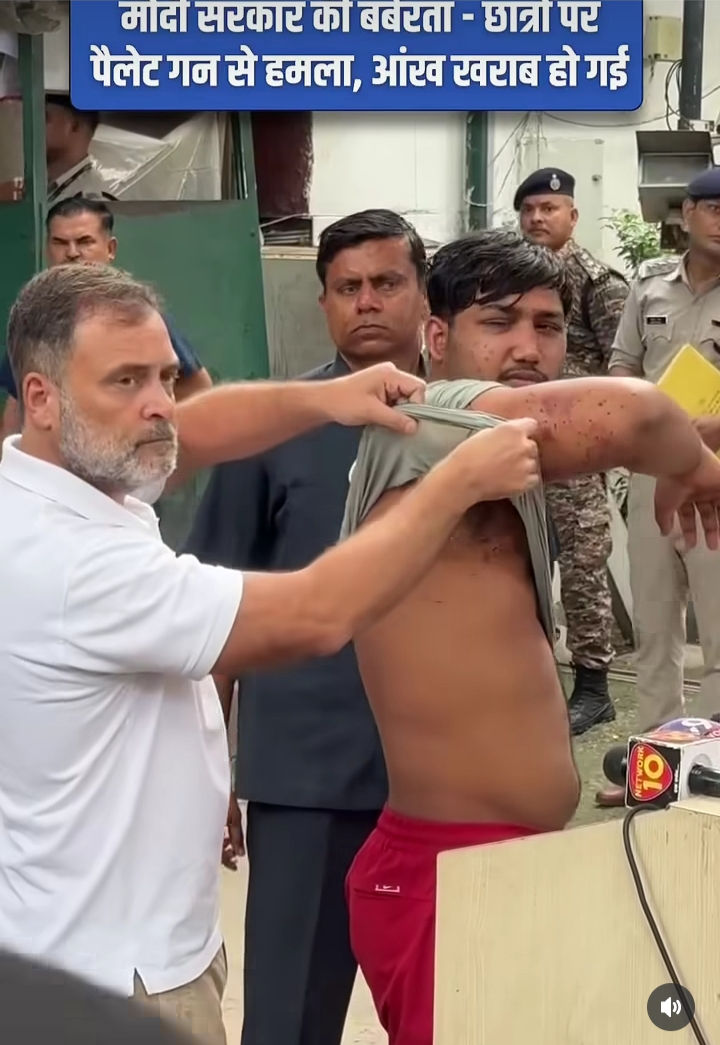
Three days after the massive and peaceful students’ march to Parliament on July 20, 2026, at least four people were in Delhi hospitals with wounds their doctors have linked to pellet-firing shotguns, a ‘dangerous’ weapon whose use against civilians outside Jammu and Kashmir is unprecedented.
By Kashmir Times News Desk
Three days after police and paramilitary personnel broke up a student march to Parliament on July 20, 2026, at least four people were in Delhi hospitals with wounds their doctors have linked to pellet-firing shotguns, a crowd-control weapon whose use against civilians outside Jammu and Kashmir is unprecedented.
Delhi Police have repeatedly denied firing pellets, calling the reports "false and misleading." The dispute is now before the Delhi High Court in a batch of public interest litigations, after it was briefly but unsuccessfully raised before the Supreme Court.
The apex court refused to intervene in the police brutality plea with Chief Justice of India Suryakant remarking, “We are not interested in videos; we don’t have time to watch.”
The protest movement behind the crackdown grew out of anger over an alleged paper leak and other irregularities in exams run by the National Testing Agency, particularly the medical entrance test NEET.
Calling itself the Cockroach Janta Party (CJP), a label protesters adopted after CJI Surya Kant compared young activists and journalists to cockroaches, the group had held a sit-in at Jantar Mantar for roughly a month, including a hunger strike by activist Sonam Wangchuk, before calling a march to Parliament on July 20 under the banner -- Sansad Chalo.
Thousands gathered at Jantar Mantar that morning. When peaceful protesters tried to push past barricades toward Parliament, Delhi Police, backed by the Rapid Action Force (RAF), the anti-riot wing of the para military force, Central Reserve Police Force (CRPF), responded with baton charges and tear gas, as stone-pelting broke out in places.
By evening, CJP spokesperson Saurav Das was alleging on social media that police had fired pellet guns at peaceful demonstrators; Delhi Police rejected the claim within hours.
Delhi Police's own count put the number of injured protesters at around 60. Other tallies, including one attributed to The Hindu, put the figure at roughly 80, and lawyers later told the Delhi High Court that more than 90 students had been hurt. Multiple FIRs were registered across central Delhi police stations.
To disperse the largely peaceful march, Police and Rapid Action Force (RAF) used not only tear gas and batons but also shock batons -- batons with nails and pellet shotguns.
A video was posted by The Dalit Voice on X capturing the firing of a pellet shotgun by a member of the Rapid Action Force in New Delhi at protesting students:

The Pellet Count so far
Shaikh Irshad Mansoori, 25, a Jabalpur native working in Gurugram, was near Palika Bazaar in Connaught Place, hands raised, telling officers he and those around him were peaceful, when something suddenly hit his face and shattered into fragments.
Surgeons at Lady Hardinge Medical College removed pellets from below his eye and from his facial cavity; a third, lodged near a blood vessel in his neck, was considered too dangerous to remove immediately.
Doctors explicitly used the term pellets in explaining his injuries, he said, and the personnel he saw firing were "wearing blue uniforms", typically worn by the RAF personnel.

Sahil Lochab, 19, a Delhi University distance-learning student from Najafgarh, who has been preparing for the police recruitment exams, was carrying the national flag at the front of the march when he heard what he later described as an explosion near his face.
He was shuttled between three hospitals -- Lady Hardinge, Safdarjung and finally AIIMS -- before receiving full treatment. His uncle, Ajay Duggal, recalled asking what he could see out of the injured eye; Lochab's reply, as Duggal told the news agency PTI, was that it was "pitch black".
Doctors initially gave the family only a one-in-a-hundred chance his vision would return. Scans reportedly found a pellet lodged in his right lung and in the pericardial fat surrounding his heart, along with a corneal perforation.
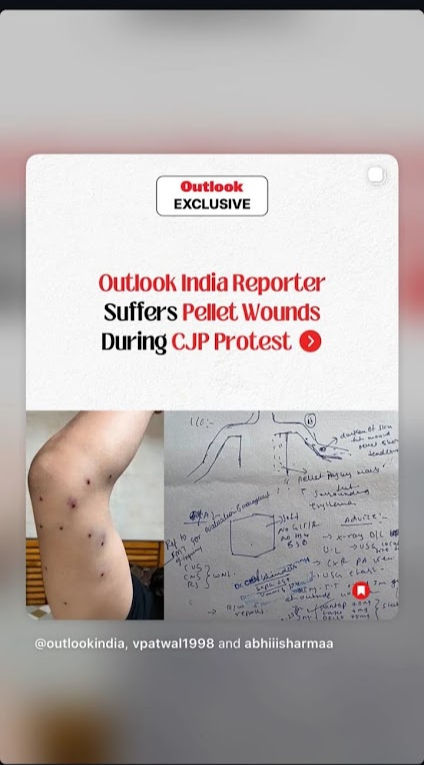
An Outlook reporter covering the march near Jantar Mantar said an officer raised what looked like a gun in his direction. "I saw it aimed at me and immediately ran," he said, and was struck in the backpack and arm as he turned. He says the turn spared his chest and face.
Medical records the outlet published documented multiple puncture wounds; the incident occurred near the same Palika Bazaar entrance where Mansoori was hit.
A fourth case circulated on social media, including posts by Alt News co-founder Mohammed Zubair, but this "fourth victim" remains anonymous. Outlets including Maktoob Media covered the same cluster of injuries.
Other protesters were hurt in ways unconnected to pellets; 21-year-old Sakshi was trapped beneath a crush of demonstrators near Tolstoy Marg and was taken off ventilator support after emergency treatment. A 19-year-old NEET aspirant needed stitches after an alleged baton blow to the head, and a 32-year-old woman underwent surgery after a tear gas shell struck near her ear.
In denial
Delhi Police has stated that their personnel do not possess or use pellet guns, labelling any contrary claims as misinformation that could lead to legal consequences.
Since pellet guns are not standard issue for the Delhi Police, the focus has shifted to the Rapid Action Force (RAF), which does carry them and was deployed in significant numbers on July 20. However, neither the RAF nor its parent organisation, the Central Reserve Police Force (CRPF), has directly confirmed or denied their use of pellet guns.
Independent reporting has tried to close that gap. Alt News fact-checkers geolocated footage placing both Mansoori's and Lochab's injuries within a few hundred metres of video showing an RAF jawan raising what an ammunition expert identified as a 12-bore pump-action shotgun.
The Wire separately reported that a professional shooter and other experts have identified the weapon visible in RAF hands on July 20 as the same type of gun. Union Health Minister J.P. Nadda visited Mansoori in hospital on July 21.
Alt News has argued that this shows the government is aware that pellet-injury patients are being treated in Delhi's hospitals.
No independent forensic or ballistic report confirming the nature of the projectiles had been made public as of this writing.

The courts weigh in
On July 22, the Delhi High Court heard a batch of PILs alleging excessive force. Senior advocate N. Hariharan told a bench led by Chief Justice Devendra Kumar Upadhyaya that children had been beaten with nail-studded lathis, that pellets and electric batons had been used against a peaceful crowd, and that some women protesters had been assaulted by police officers, seeking FIRs against identifiable personnel.
Senior advocate Gopal Sankaranarayanan said his team had reviewed more than 130 videos showing excessive force and personnel operating without name tags, arguing that authorities had ignored safeguards laid down by the Supreme Court in the Ram Lila Maidan case governing how assemblies may be dispersed.
Appearing for the Centre and Delhi Police, Additional Solicitor General S.V. Raju dismissed the petitions as publicity-seeking, resting on unverified social media videos, and argued that anyone assaulted had statutory remedies before a magistrate rather than a claim on the high court's writ jurisdiction.
The bench disagreed that individual complaints could substitute for a PIL given the scale of the allegations, and ordered the Centre and Delhi Police to preserve CCTV footage, videography, and other records, directing them to respond within four weeks. The matter was listed for further hearing on September 11, 2026.

The Pellet Gun
A pellet gun is a .12-bore pump-action shotgun that fires a cartridge loaded with several hundred lead or metal pellets, spherical or irregular, that disperse over a wide area rather than travelling as a single projectile, at speeds reported around 1,000 feet per second.
Standing orders call for aiming below the waist from a minimum distance, but at close quarters, or when aimed higher, pellets can penetrate soft tissue and prove lethal, particularly to the eyes.
Shock batons, also standard RAF equipment and reportedly used against at least one woman protester on July 21, were the subject of 2021 specifications issued by the Ministry of Home Affairs through the Border Security Force: a device no heavier than 1 kg, between 450mm and 700mm long, built to withstand temperatures from −20°C to +50°C, with a minimum five-year service life and the ability to deliver at least 1,000 quarter-second shock bursts on a full charge.
Official guidance describes a graduated hierarchy of force. According to replies the ministry of home affairs has given Parliament, security forces are expected to first attempt STUN-LAC shells and PAVA (chilli) shells and grenades, and tear smoke shells.
Only if these fail to disperse a violent crowd should personnel move to rubber or plastic bullets, and pellet guns. Personnel are meant to receive three days of specialised training beforehand.
An Indiscriminate Weapon
Officials have long defended pellet guns as the least-bad option once a crowd turns violent: the CRPF itself has described the weapon as the “least-lethal tool” it has for crowd control, intended to disperse dangerous mobs while avoiding the higher death toll of live ammunition. This was the explicit rationale for introducing it in Kashmir in 2010.
The UN human rights office has called pellet-firing shotguns "one of the most dangerous weapons" used in Kashmir, and international policing standards favour the term less-lethal over non-lethal, precisely because the weapon can still kill, blind or permanently disable. The casualties are well documented in Kashmir.
Kashmir: Where it all began
Pellet guns entered Indian policing in Jammu and Kashmir in 2010, after 112 protesters were killed in conventional police firing during that summer's unrest. The then Congress-led central government approved the weapon as a supposedly non-lethal alternative meant to spare civilian lives.
The weapon that was occasionally used became the staple after 2016.
That justification came under sustained strain after July 8, 2016, when Hizbul Mujahideen commander Burhan Wani was killed in an encounter, triggering the largest unrest the Valley had seen in years. As protests and curfews spread, security forces, chiefly the CRPF, used pellet guns extensively to disperse crowds, and the human cost proved severe.
The scale of harm is documented across government replies, court filings, hospital records, and rights-group reports, which vary.
A Valley Blinded
Behind the statistics are lives permanently altered. A 17-year-old boy preparing for competitive exams, was walking near Nowhatta in downtown Srinagar the day after Wani's killing when security forces fired on the crowd. Two pellets entered his eyes. "It was like someone just switched off the world," he told Kashmir Times nine years later, from a dim room he now rarely leaves.
Both eyes were destroyed; he has an artificial eye implanted but remains totally blind and dependent on his family
Another young girl, who had hoped to become a doctor, was hit by pellets in mid-August 2016 as she stepped outside her family's home to call her younger brother in from the street. She lost vision entirely in one eye and retains only partial sight in the other despite four operations and was forced to abandon her studies.
The most widely recognised face of Kashmir's pellet-gun crisis is Insha Mushtaq, who was 14 when she opened the window of her home in Sedow village, Shopian district, on July 11, 2016, to watch protests over Burhan Wani's killing and was struck by a volley of pellets fired by security forces outside.
More than a hundred pellets tore into her face and skull, several penetrating both eyes and fracturing the bones around them; doctors at Srinagar's SMHS Hospital, who could only focus on saving her brain rather than her sight, called it "the worst we have ever seen" and declared her permanently blind.
Fighting it in court
Litigation over pellet guns in Kashmir predates the 2016 unrest, but in December 2016, a bench led by then Chief Justice TS Thakur issued notice to the Centre and the J&K government and ordered an expert committee report to study alternatives.
By March 2017, arguing before a bench led by Chief Justice JS Khehar, Attorney General Mukul Rohatgi maintained the choice of weapon could not be judicially determined, while the bench itself observed that "what can be adopted should not cause harm to individuals."
The court declined to order a ban but pressed the government to pilot alternatives at four or five high-frequency protest sites and report to it. The following year, the CRPF began issuing plastic-headed rounds, developed by the Defence Research and Development Organisation (DRDO) and manufactured at an Ordnance Factory in Pune.
Later petitions seeking an outright ban were dismissed by the J&K High Court in 2020.
What rights groups say
Both Human Rights Watch and Amnesty International have called for pellet-firing shotguns to be banned outright. Human Rights Watch has argued the weapon causes harm that goes well beyond what international policing norms permit.
Amnesty International's 2017 report on Kashmir made a similar case, arguing the weapon simply cannot be aimed at a single target, and a broader 2023 Amnesty study of kinetic-impact projectiles worldwide tied comparable weapons to severe eye trauma, bone fractures and internal organ damage among protesters in several countries.
The Office of the UN High Commissioner for Human Rights has urged that any such weapon be used strictly in line with the principles of necessity and proportionality. It suggested that this standard in Kashmir's experience routinely failed to be met.
Kashmir is not the only place pellet guns have surfaced outside Jantar Mantar. During the ethnic violence that convulsed Manipur in 2023, allegations of pellet gun use against protesters caused public outrage, though authorities did not confirm deployment. Similarly, in 2024, during the farmer’s protracted and peaceful moment, leaders at the Khanauri and Shambhu border points on the Punjab–Haryana boundary alleged police used pellet guns against protesting farmers. Police denied it.
For a country where this weapon's history runs almost entirely through one restive region, Delhi's crackdown has reopened a question Kashmir has been asking for sixteen years: whether the safeguards courts have demanded for pellet guns are being followed anywhere the weapon is used at all?
(The article appeared in the ‘Kashmir Times’ on July 23, 2026. It can be accessed at: https://kashmirtimes.com/news/the-cost-of-non-lethal-kashmirs-pellet-gun-legacy-and-its-return-to-delhis-streets)
Courtesy Kashmir Times
Photos of Rahul Gandhi and Sahil courtesy / Instagram / Social Media