


Manipur: Report to the Nation
- Sep 29, 2025
- 5 min read
Indeed, what is it that caused the outbreak of violence in Manipur on May 3, 2023, and who was responsible for stoking the fire over the next two years?
Independent Ink Copy Desk
After 28 long months, Prime Minister Narendra Modi finally visited the battered and bruised state of Manipur in the North-east of India on September 13, 2025. Much was expected from his rather belated visit. The people hoped that the PM would provide solace to the survivors and victims who had suffered ever since May 2023, when ethnic violence between the majority Meitei community and the Kuki-Zo and Naga tribals spilt out on the streets.
According to official figures, over 260 people have so far died in the violence, and over 1000 people have been injured. A staggering 60,000 have been displaced, thousands of homes burnt or destroyed. Women were raped, paraded naked on the streets, and several churches and Hindu temples were attacked and vandalised.
But, despite this horrific backdrop, the PM chose to announce a few projects and left the state as if nothing had ever happened. Many local citizens found this to be rather insensitive.
Paolienlal Haokip, BJP MLA from Churachandpur, one of the areas affected, did not hide his discontent with the visit. He told journalist Karan Thapar in an interview posted by The Wire that the visit “might serve political optics”, but “as far as addressing core issues, it was not what was expected. It was disappointing”, he said.
Indeed, what is it that caused the outbreak of violence on May 3, 2023, and who was responsible for stoking the fire over the next two years?
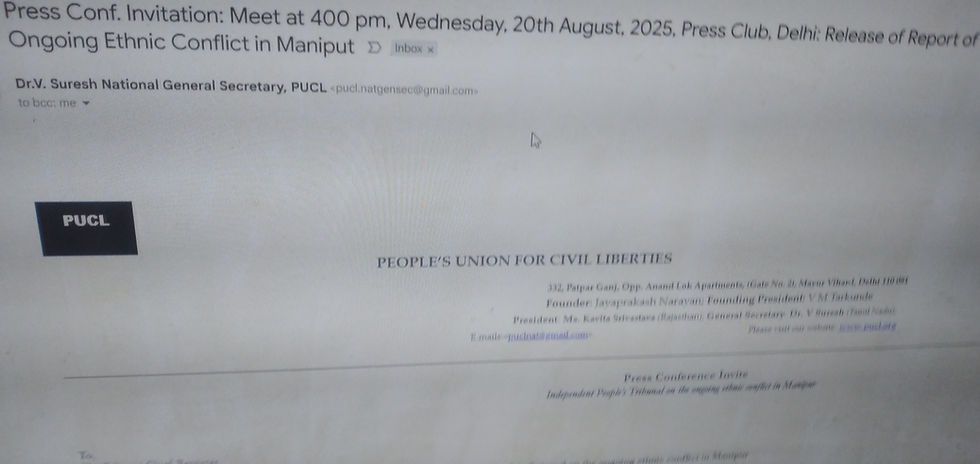
A 694-page report titled Report to the Nation, released last month by an Independent People’s Tribunal set up in 2024 by the People’s Union of Civil Liberties (PUCL), provides valuable insight into the ethnic conflict. It also has a set of recommendations to bring Manipur back on an even keel.
The 14-member Tribunal, chaired by former Supreme Court judge, Justice Kurian Joseph, also included on the jury Justice K Kannan, Justice Anjana Prakash, former bureaucrats MG Devasahayam and Swaraj Bir Singh, eminent academics Uma Chakravarti and Virginius Xaxa, and prominent human rights activist Manjula Pradeep, Henri Tiphagne, and Akaar Patel. Three subject experts also assisted the tribunal.
Over 150 victims and survivors deposed before the Tribunal. Many more joined group discussions, and others interacted virtually. Jury members of the Tribunal and experts visited the conflict-affected areas in Manipur. They held sittings in several districts, including Bishnupur, Churachandpur, Imphal East, Imphal West, Kakching, Kangpokpi and Senapati.
The team members also visited several relief camps to speak with survivors, including children, women, and the elderly, who were displaced. Testimonies of internally displaced persons and representatives of the different ethnic communities -- Kukis, Meiteis, Nagas were recorded. All stakeholders, including social workers, government and security officials, were contacted.
The findings and observations in the Tribunal’s report can be distilled into the following key points:
1. According to the report, the testimonies of the survivors present a “stark picture of the failure of the state authorities and institutions to protect them”. The jury also notes the “failure of the central government to fulfil its constitutional responsibility to ensure that Manipur remained under the regime of both rule of law and the Constitution”. The evidence placed before the Tribunal lays bare the “gruesome and systemic nature of the violence, the role of the radical groups, the failure of state institutions…”
2. Much before violence erupted on May 3, 2023, there were divisive factors at play, including historical ethnic divisions, socio-political marginalisation and land disputes. But mistrust and enmity between communities, were whipped up in the prelude to the conflict through “systematic hate campaigns” in sections of press and on social media and by “statements by the political leadership”.
3. The Manipur High Court’s March 27, 2023 directive recommending Scheduled Tribe (ST) status for Meiteis served as a “vital trigger”. It was seen by the tribals, including the Kuki-Zo and the Nagas, as a threat to their constitutional protections. It sparked protests across all tribal districts, leading to a major protest on May 3, 2023, in all the Hill districts. Violence soon erupted in a few places, quickly spreading across the state.
4. The jury learnt that several false narratives dominated the discourse around the conflict. Meitei deponents before the Tribunal alleged “continuous immigration of Kuki-Zo communities from Myanmar”. However, after reviewing the data, the tribunal found that the allegation of population influx, raised by the Meiteis, and some political forces, was unfounded.
4. Another falsehood was linking Kukis to poppy cultivation. This dovetailed with then Chief Minister Biren Singh’s ‘war on drugs’ and translated into propaganda against Kukis that criminalised and demonised them. According to Kuki deponents, the key players in poppy cultivation came from different communities, particularly those with powerful connections.
5. According to the report, a section of the media played a role in the conflict by influencing public perception and escalating tensions. While the print media was partisan, digital channels and social media were used to spread false news and inflammatory content.
6. According to the report, the violence “was not spontaneous, but planned, ethnically targeted and facilitated by State failures”. There was a deep-rooted belief among survivors and victims that the State either allowed the violence to happen or actively participated in it.
7. The jury found the brutal nature of the violence disturbing. People were reportedly killed, butchered, tortured, dismembered, disrobed and sexually assaulted in public, and images displayed through social media. The report documents alleged widespread sexual violence during the conflict, with many incidents going unreported due to fear, trauma and lack of institutional support. The jury noted that women who sought protection from the police and security forces were not only refused help but, in some instances, were allegedly handed over to violent mobs.
8. The jury found the relief and rehabilitation measures grossly inadequate, delayed and unevenly distributed. Many relief camps suffered from poor sanitation and hygiene, inadequate healthcare, absence of mental health support and lack of livelihood and education restoration.
9. According to the report, the jury found that the state witnessed a complete breakdown of constitutional mechanisms. Urgent directives to protect life and property should have been issued. The law enforcement authorities did not respond urgently to emergency situations. The report blames both the state and central governments for the denial of justice and displacement of the affected people for over 27 months.
In the concluding part of the report, the jury makes several recommendations:
It calls for establishing a permanent bench of the Manipur High Court in the hill region for better access to justice. It recommends the setting up of a Special Investigating Team (SIT) to probe the thousands of cases arising from the conflict and also look into the role of security officers and police. The jury adds that those responsible for hate propaganda and inflammatory speeches need to be prosecuted, along with action taken against the authorities who failed to exercise their powers to prevent it.
The jury makes a compelling case for a restorative justice framework for addressing grievances and promoting healing, which is “hinged on acknowledging harm, reparations, and reintegration over mere punishment”.
The report points out that accountability and justice are foundational to rebuilding trust, democracy and coexistence in Manipur. It calls on India’s judiciary, Parliament and civil society “to reclaim this duty and ensure that Manipur does not become a template for future impunity”.