If God did not Exist: Ganesha, Swati and the White Peacock
Updated: Apr 27
Swati found Parvati’s relationship with Shiva intriguing. Such was the relationship that she, too, would prefer with a god or a human. Yes, she thought idly to herself: this bit about immersing oneself in another person and then dissolving all sense of self, was definitely a trifle overwhelming.
By Ratna Raman
Swati’s father wasn’t really willing to examine the balance provided in Voltaire’s construction or analyse the situation in the manner of Voltaire. His parents were devout temple-goers, and his maternal grandfather had been a temple priest. Unlike Voltaire, who lived on the continent centuries earlier, Swati’s father was born in India in the twentieth century, and when he came of age, India asserted her independence from colonial rule. In a country peopled with gods, Swati’s father watched the precarious fabric of the nation shift and heave under the warp and weft of class and caste and religion.
By the time he had grown up and grown old, he also managed to formulate his own credo. “God made man,” he told Swati over and over again: “Man made religion and caste and religion and caste made fools of everyone.”
Swati, who studied in a convent school, was moved by the fluency of this expression and its symmetry as it delineated cause and effect for times to come. She herself had been born in a temple town, and both sets of grandparents and her mother celebrated their countless gods on a daily basis.

Innumerable anecdotes from the lives of gods were narrated to her, and she was also introduced to a long line of humans who had interacted with the gods. The stories were delightfully pithy and often enough pragmatic, and wise.
Swati grew up juggling, sometimes unsuccessfully, her acquired scientific education, along with her inherited fascination for stories centred around myriad Hindu gods.
She learnt in her youth of Mirabai, who loved Krishna, of Uma, who courted Shiva assiduously, and of Andaal, who pledged herself to Vishnu. Before Swati could follow suit and devote herself to one specific god, she discovered that she was quite happy to be by herself and explore the many textured world she inhabited.
Swati loved to draw, sketch, and paint, and she drew the most amazing kolams (a traditional South Indian floor art form, often created daily at household entrances by women using rice flour, chalk, or coloured powders) whenever there was a festival. On other days, she made Warli paintings on the walls of her house, choosing them over Madhubani art because you needed only one colour to do a painting in the Warli style, pretty much like the kolams which she could draw with dry or ground rice flour, occasionally framing the white kolam with the terracotta red kaavi border.

It was around this time that she found herself very fascinated by the elephant-headed god, Ganesha. He seemed to be around most of the time. He had begun life, made from the Goddess’s own spirit, grit and sweat, and this precious part of herself she formed into a body, appointing him to ensure that nobody could disturb her when she was busy.
It so happened that Shiva often strode into her chambers without notice, so she stationed this self-fashioned child at the entrance to remind Shiva of the need for boundaries. Swati admired Parvati, because she not only chose to marry Shiva on her own accord, but also strove to nurture separateness.
When the gana debarred entry, Shiva beheaded him and felt the brunt of Parvati’s anguish and rage. He then rushed to make amends, refixing the dis-severed head with that of an elephant calf. Parvati forgave him, since her child, albeit with a different head, had been restored to her.
Swati found Parvati’s relationship with Shiva intriguing. Such was the relationship that she, too, would prefer with a god or a human. Yes, she thought idly to herself: this bit about immersing oneself in another person and then dissolving all sense of self, was definitely a trifle overwhelming.
In fact, the more she contemplated it, the more difficult she found the idea of giving up her identity as a possible life-goal.
So it happened, that the pot-bellied god, with an elephant head, the offspring formed first by Parvati and then given life again with a new form by Shiva, struck a rapport with her. Something about him resonated: maybe it was the sight of the baby elephant at the elephant camp, or those lovely brass baby elephants that her mother picked up from Chidambaram, which now cavorted on the centre-table in the living room.
Perhaps it had everything to do with the prayer her mother had taught her as a little girl.
Life, mother always said, was full of situations in which one could get stuck. One needed tremendous will power and resilience, and one also needed divine grace to surmount obstacles.
Swati got the bit about the need for will power and resilience to come unstuck. How did one go about obtaining divine grace? she enquired of her mother.

The good thing was, amma always had a repertoire of mantras that she invariably offered as a solution. Amma sat her down, taught her a shloka, and made her commit it to memory. She copied it down and then recited it slowly, her hands following the crisp Sanskrit words written in her large slanting hand, which invoked Ganesha:
"वक्रतुण्ड महाकाय सूर्यकोटि समप्रभ:।
निर्विघ्नं कुरु मे देव सर्वकार्येषु सर्वदा ॥"
(vakratunda mahakaya, suryakoti samaprabha, nirvighnam kurumedeva, Sarva karyeshu sarvada)
This mantra was a shout out to Ganesha for help, invoking the god with a curved trunk, large in body, and as mighty as the sun to clear all obstacles, for all activities, at all times.
Amma was very matter-of-fact about it all. “This is Kaliyuga”, she informed Swati. “The gods do not appear in front of humans as they did in the previous yugas. The mantra strengthens our resolve when we seek support.”
Swati learnt this mantra by rote, much in the manner that she committed so many other details to memory. This was repetitive work, and she wondered if it was called learning by heart, because one had to feel very strongly to commit something to memory.
She summoned the mantra to her aid often enough when she walked alone through dark streets where ugly men often prowled, or if she lost an earring or a borrowed book, when her math test was coming up or if terrible results were expected, and somehow, for whatever it was worth, the prayer seemed to sort out altogether the tricky situation at hand. Swati was grateful for this rotund, genial, behemoth with a sweet tooth, who loved food and fun and was so punctual and alert that both humans and gods relied upon him, invoking him whenever a crisis was at hand.
Over the years, Swati established an insouciant comradeship with Ganesha. The first wood carving she bought at Poompuhar was an exquisite image of his. She began to collect little brass Ganeshas in stone, silver, clay and ceramic and glass, till her house was filled with elephant trunk figurines that spilled out of cupboards, sat as mantelpieces, climbed walls and even wandered into her little terrace garden.
More of them made their way into her home, year after year. When Saroja walked in with a Ganesha made of resin, his skin all pink, clad in gold ornaments, dressed in muted orange and resting against a deep green bolster, Swati fell in love with the sculpted God all over again.
“I have to place him where I can see him all the time,” she said to Saroja, and then decided to seat him in the balcony niche outside her study table. So there Ganesha sat, looking at her, half smiling as she studied and prepared for her exams: for Swati was training to be an art teacher at the local school.
She continued to invoke him, more often than not when the key to her cupboard jammed or if her computer would not switch on. Invariably, one Ganesh shloka later, things would improve vastly in the matter of resisting cupboards and reluctant servers.

Over the years, Swati had dispensed with the shloka. Now all she needed to do was to call out or look at Ganesha, through the glass-paneled window in front of her study desk and obstacles seemed to shrivel up and slowly disappear. Thanking him for his support and friendship, she informed Ganesha that she wanted to work with art and craft and that she needed his help.
“Sorry” he replied, shrugging his shoulders, “I am through with breaking further bits of my tusk and bruising myself in order that you may achieve success as a craftsperson.”
Swati looked up and smiled, noting that not very much was left of his tusk, and even the Japanese kintsugi (joining broken pieces of pottery and filling the cracks with gold powder) wouldn’t help, for Ganesha with an unbroken tusk would be an ordinary elephant, instead of this extraordinary friend.
“I guess you now have Dictaphones,” Ganesha continued. “So scribes are no longer relevant. I don’t really need to draw anything for you, your computer has a memory card. Also, for the record, your generation took away my mouse, a long while back and has put his nose to the grinding stone. He is a weary fellow at the end of the day, a sort of digital nerd, so I don’t really feel inclined to contribute. I am sure you can handle this without me. Besides, this is Kaliyuga.”
Swati considered this. For someone from another time, she conceded, nothing he had said could be faulted, although she didn’t see how Kaliyuga was relevant.
Besides, didn’t the books also say that God helps those who help themselves?
She nodded. “I agree with everything you have just said. I will work at bettering my skill, since I know that I only need to look out of the window if I need your help. However, since this is a free and equal relationship, and you have done so much for me and also lost your mouse steed, do let me know what I can do for you?”
Ganesha smiled. “I like the idea of friends with benefits”, he remarked. “Ever since tech-savvy humans turned my mouse into an indentured accessory, I have been unable to travel. My girth hampers my mobility (despite the mirth it causes, and I’m overlooking the fat-shaming), and I don’t fancy floor-hopping to get around.”
“I see your point”, Swati replied. “You require a suitable vehicle. Since the mouse is now taken and was never very commodious, given your spread, let me find you an alternative mode of transport.”
“Do you know”, said Ganesha, “my sibling, Kartikeya, wisely chose the gorgeous blue peacock.”

“Yes”, Swati replied, “it is also our national bird.”
“Hmm, I am aware!” said Ganesha wistfully.
Wait a minute, said Swati triumphantly as she caught in her cupped hands an idea moving at the speed of light in her direction. “Both India and Kartikeya have chosen the blue peacock. Would you settle for the white peacock?
She knew she had prevailed when she saw the glint in Ganesha’s eye.
“Yes of course,” he responded with glee, nibbling at the modak in his hand. “That is a splendid idea. So will you organise a white peacock for me?”
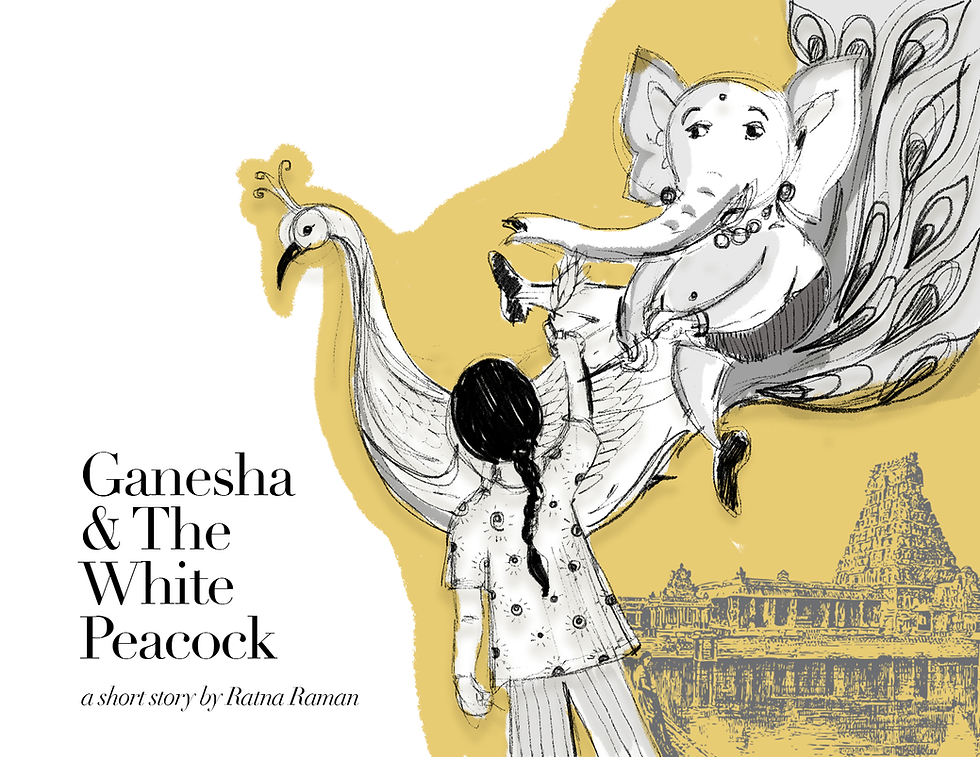
“Yes I shall,” said Swati. She shut down her laptop and began rummaging through a range of materials wondering how to go about it. Her eye fell on a pile of broken tiles, left over from the house repairs. Rummaging through a rubble of broken bits, she made a mosaic, piece by piece, sticking them onto the farthest end of the balcony wall. From the bits of tile and white cement there emerged a large white peacock, one that Ganesha could comfortably sit astride on, and travel to destinations of his own choosing. Swati gave the white peacock the most beautiful tail, using several intricately hand-painted Khurja ceramic coasters.
Ganesha beamed from ear to ear when Swati returned to her table and waited for the mosaic to dry.
“That is very well-executed,” he remarked, “and I look forward to countless new beginnings.” Swati grinned at him, pleased that she had been able to assist her old friend and ally.
That was how Ganesha got the better of things, although he had been unfairly swindled of his mouse, in the first place. His friendship with Swati enabled an upgrade to his mode of conveyance. The white peacock, perched proudly on Swati’s wall, made for a dazzling escort.

To this day, you can find both Ganesha and the white peacock on the small balcony, outside Swati’s study window.
Ganesha’s torso and face continue to glow as a result of all the fresh air that peacock rides made possible. As for the regal white peacock, his magnificence and elegance has pretty much convinced everyone that White is now the new Blue.
White peacock is delighted about meeting cousin Blue Peacock frequently, now that both of them work for members from the same family. Sometimes on weekends, when both brothers visit their parents, the peacock cousins catch up on all the news, albeit raucously, while enjoying the run of the mountain range and the trees.
On occasion, late in the evening, Swati, unable to spot either Ganesha or the white peacock, wonders dreamily about their whereabouts. Most mornings, however, when she does glimpse them, the peacock with his magnificent tail spread out on her balcony’s wall, and Ganesha sitting against the solid niche, she goes about her work with a spring in her step, joyful and content in her friendship.