


Here’s an idea: MAKE MORE REELS
Updated: Aug 9

When liberty stops asking permission: For that, people must step forward. They must speak, disagree, refuse, mock, ridicule, gather, unite, and sometimes make authority uncomfortable.
By Narendra Pachkhédé in London
After the new Prime Fraand of the Cockroaches had finished explaining the young to themselves through a newfound series of Instagram unreelings, the smile was gone. The phone camera gave way to a graver register. The Republic had summoned its philosopher.
Every government that begins by asking for patience eventually begins explaining liberty. First come the appeals for understanding. Then the assurances that the young have been misled. Then, almost inevitably, comes the philosopher, gently warning that freedom is not what they imagine it to be.
There is something almost biblical about the sequence.
First comes forgiveness, then instruction. The errant child is embraced before being told why he has misunderstood the world.
By then, the leaked examination paper has disappeared. So have the delayed recruitment, the wasted year and the long apprenticeship in waiting. The subject is no longer institutional failure.
It is the moral education of the citizen.

Those Who Have Done All the Waiting
No student who has watched an examination collapse after months of preparation believes that freedom means doing whatever one wants. No family that has borrowed money, sold jewellery or postponed other needs to finance coaching classes requires a lesson in limits. No graduate moving from one recruitment notice to another, one postponement to another, needs to be told that life demands patience.
They have waited through revised schedules, committees, inquiries, assurances and yet another date that will supposedly settle everything.
Responsibility moves from one department to another until it can no longer be found. The failure is institutional, but the cost is private.
Only when they are in the streets does the argument change.
What began as a question of institutional credibility becomes a question of youthful behaviour. Protest is no longer treated as a response to failure -- but as evidence of immaturity. The State does not deny the right to dissent. It does something more effective. It narrows the meaning of dissent until only its most obedient form remains recognisable as liberty.
You may speak, but not like this. You may disagree, but not so loudly. You may protest, but not in a way that makes authority uncomfortable.
The distinction begins to turn back upon itself.
The deeper confusion does not belong to the protesters. It lies in the regime’s effort to reduce freedom to private choice while remaking liberty as disciplined conduct before authority.
One is free to scroll, consume, choose, complain or even mock, provided none of it becomes politically consequential. Liberty comes to mean knowing one’s limits.
But, who sets those limits? And who is expected to live inside them?
Political freedom has never been only a private possession. Hannah Arendt understood it as something that takes form when people speak and act together in public; Philip Pettit, working in the republican tradition, argues that liberty as freedom from domination: not merely freedom from interference, but freedom from living under power capable of acting arbitrarily, without being answerable to those subject to it. Neither account has much in common with the paternal lesson now being offered to India’s young.
They are not asking to be freed from responsibility. They are asking why responsibility seems to travel in only one direction.
The Cockroach Janata Party understands this not through theory, but through language.
When Mockery Becomes Political Speech
The insult was meant to diminish them.
Cockroach: dirty, unwanted, disposable, something to be stamped out so that normal life could resume. Instead, they kept the name. They did not ask to be renamed more respectfully. They stayed with the insult until it began to expose the contempt that had produced it.
The movement does not come before the State in the language of the properly aggrieved citizen. It does not perform gratitude for being heard. It does not promise in advance that its anger will remain tidy.
It answers solemnity with parody, official Hindi with a mixed and unruly vernacular, political sermons with memes.
This is easy to dismiss as unseriousness. But they may sound unserious because they have watched seriousness become a performance.
It is the old game of kicking the can down the road. A petition disappears into an office. An acknowledgement is issued. An inquiry is promised. Another date is announced. Another paper leaks. Somewhere, someone makes a joke.
The joke travels farther than the official clarification.
States understand anger. Anger can be fenced, filmed, dispersed and prosecuted. Governments understand speeches, delegations, memoranda and hunger strikes. They understand the choreography of respectable dissent.
Ridicule is less manageable.
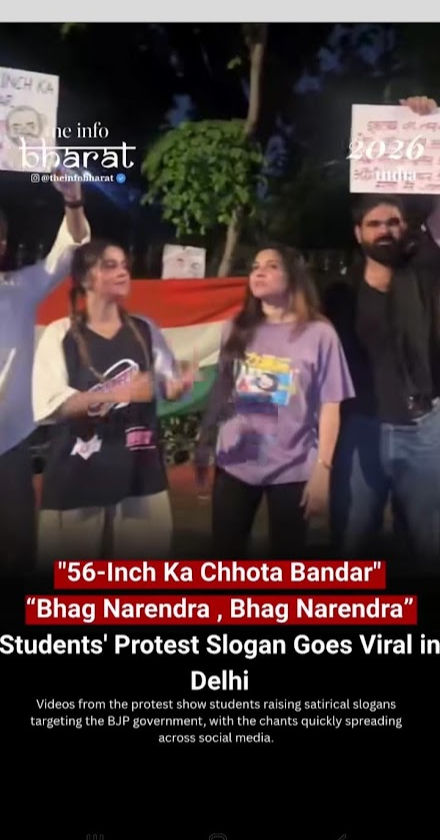
Mockery does not simply oppose power. It withdraws the tone through which power expects to be addressed. It refuses the old agreement that authority may fail repeatedly and still be spoken to with deference.
That may explain the sudden concern with liberty.
The issue is not that the young have become incapable of seriousness. It is that they no longer regard the State’s seriousness as self-evident. They have watched solemn announcements give way to administrative silence. They have seen institutions ask for trust after providing little reason for it. They have been made to carry the consequences of disorder and are then warned against becoming disorderly.
The contradiction is almost vulgar.
There is responsibility attached to protest. Of course there is. But examination boards have responsibilities too. Recruitment agencies do. Ministers do. Police forces do. Governments do.
Those who ask the young to exercise restraint might begin by asking what restraint power has exercised upon itself.
Only then does the lecture on liberty make political sense. It is not the protesters who have confused liberty with licence.
The State has begun to confuse liberty with obedience.
Liberty is not a reward for good behaviour. It allows citizens to speak, assemble, ridicule and resist without being cast outside the political community. It exists not because governments welcome dissent, but because governments often do not.
The cockroaches are not asking for the right to do whatever they want. They are asking why institutions seem increasingly able to do precisely that.
Why may an examination fail without consequence?
Why may a recruitment process collapse into delay?
Why may a protest be cleared faster than the grievance that produced it is answered?
Why is the citizen always asked to wait while authority speaks as though it has already explained enough?

The warning is that India’s young may mistake freedom for liberty. It may be closer to the truth to say that they have rediscovered liberty because private freedom has proved insufficient.
The freedom to scroll does not repair an examination system. The freedom to consume does not create employment. The freedom to complain online does not make institutions answerable.
For that, people must step forward. They must speak, refuse, mock, gather and sometimes make authority uncomfortable.
The question is not whether India’s young understand liberty. It is whether the Indian State can recognise liberty when it no longer comes deferentially or asks permission before speaking.
Here’s an idea: make more reels.
Open Hannah Arendt’s “What Is Freedom?” and read it to the country. Pass it from one phone to another, one campus to another, one language to another.
Read it because freedom is not the State’s gift to well-behaved people. It is what citizens discover together when they step into public life, speak without permission and insist that power answer for itself.
Then ask again what liberty means.

Narendra Pachkhédé is a critic, writer and essayist who splits his time between Toronto, London and Geneva. His latest book is Form As History: When History No Longer Requires Us (Daraja Press, 2026).
All photos courtesy Instagram / Social Media