


‘Guns may shoot, and knives may carve, but we won’t wear your silly scarves'
- Jun 5
- 4 min read

Marjane Satrapi (1969-2026) -- Tribute: As we bid adieu to a great rebel, graphic artist, filmmaker writer, and human being, with a deep sense of grief, her loss resonates personally for many of us. She taught us that remaining human, especially in times of growing intolerance, is itself an act of resistance.
By Divya Trivedi in Delhi
“I had lost some of my relatives in a revolution… I had survived a war… and it’s a banal love story that almost got me.”
n Marjane Satrapi
Reading these words by Marjane Satrapi today feels tragically prescient. In her lifetime, Marjane survived revolution, repression, war and exile, but in the end, she died of grief and ‘sadness’, at the passing of the ‘love of her life’ – Mattias Ripa, Swedish producer and screenwriter, last year.
After his death, she set up the Mattias and Marjane Ripa-Satrapi Cinema Foundation to support foreign students seeking to study filmmaking in Paris.
While it is a rare and special kind of love that breaks hearts like this, it is unfortunate that she was only 56 when she died. Too soon and too sudden for the world to comprehend.
At the news of her death, I returned to Persepolis, the graphic memoir that profoundly shaped me when I first read it in the early 2000s. I expected nostalgia, and if truth be told, not to be impressed with the same intensity as before. Instead, I found myself moved to tears.
The book resonated even more deeply now. With age came a fuller understanding of the histories and forces of imperialism, revolution and dictatorship, that had once been only distant words to me.

Though an autobiographical comic book rooted in Iran, the story of Persepolis is universal, just like its author, who grew up in the Iran of the 1970s and 80s, during the Islamic Revolution and the war with Iraq under Saddam Hussein. The daughter of Marxist intellectuals and the great-granddaughter of Iran's last emperor, Marjane lived in Paris, France, for most of her life. Her graphic novel and its sequel, Persepolis 2, speak to anyone who has struggled with identity, freedom, belonging, and contradiction.
“Guns may shoot, and knives may carve, but we won’t wear your silly scarves.”

With wit, irreverence, and remarkable honesty, Marjane chronicled how daily lives were transformed by the Iranian Revolution: the imposition of the veil, the rise of fundamentalism, the closure of universities, and the erosion of personal freedoms, not just imposed by the regime but, shockingly to her, endorsed by ordinary people as well.
Her dream of studying chemistry and becoming a scientist like Marie Curie went up in smoke, yet she also felt a fierce love for her country when war loomed. In her world, complicated loyalties could coexist -- a lesson that remains invaluable in our increasingly polarised world today.
Satrapi wrote Persepolis to challenge the reduction of Iran to stereotypes of fundamentalism, fanaticism and terrorism. She believed that an entire country should not be judged by the wrongdoings of a few extremists. She wrote it to make sure that the Iranians who lost their lives in prisons defending freedom, who died in the war against Iraq, who suffered under various repressive regimes, or were forced to leave their families and flee their homeland, were not forgotten. And in the process, she gave an entire generation of women like me, and surely the generations to come after, a deep sense of belonging to a universal sisterhood and a vocabulary for resistance.
Moreover, she often said that men were important allies in the fight against patriarchy.
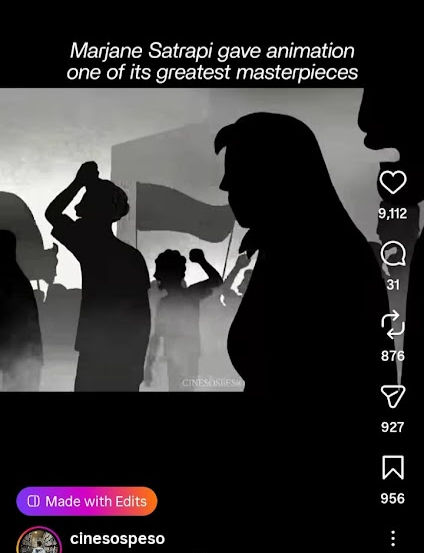
In at once being a vocal critic of the theocratic Iranian regime, Western hypocrisy, and systemic patriarchy, Marjane Satrapi laid the playbook of how to be a staunchly progressive, secular, and anti-authoritarian political activist.
Satrapi reminded us that people are not their governments:
“The world is not divided between East and West. You are American, I am Iranian… The difference between you and your government is much greater than the difference between you and me.”
Her loss feels deeply personal to many of us. Yet, mourning her is not enough.
In an age that demands rigid allegiances and simplistic narratives, remembering what she stood for may be the finest way to honour her legacy.
The refusal to surrender our humanity, our empathy, or our ability to hold contradictions is the call of the hour. Marjane Satrapi taught us that remaining human, especially in times of growing intolerance, is itself an act of resistance.
While Persepolis has obtained cult status and was adapted into a film, Marjane’s other work includes Embroideries, Chicken with Plums, and the Marie Curie biopic Radioactive, which she directed.

Woman, Life, Freedom is the name of the protracted, passionate, and glorious movement that was launched by the women of Iran 2022 after the death of Mahsa Amini, a young Kurdish woman who was arrested and murdered by the notorious ‘morality police’ for not wearing her hijab properly. It is also the title of Marjane’s book of anthology, a collaboration with more than 20 artists, writers and activists that brings the recent uprising to life.

Divya Trivedi is a Delhi-based journalist who has worked for nearly two decades with The Hindu and Frontline