


Give One Hundred Flowers to the Cockroach Who Rebels!

The language of Gen Z carries no jargon or clichés, no ideological baggage or fake theory; it is loaded (and uploaded) with scathing, digital irony. Black humour has become a defence against humiliation. Outspoken fearlessness has replaced State terror.
By Suresh Nautiyal Greenananda and Amit Sengupta in Delhi
From Salt to Water Melon
Politics has always depended upon symbols. Revolutions rarely begin only with manifestos or Constitutions; they often begin with emotive images that ordinary people instantly recognise and identify with.
The May’68 (1968) student’s uprising in Paris Nanterre University/Sorbonne against campus un-freedoms and State repression, spread like a counter-culture fire, with 10 million workers joining it. This movement spread across many countries, including in the US, and as far as Sri Lanka, and continues to inspire students till this day.
The Water Melon, in recent times, became a symbol of mass protests across the West, especially campuses, against the Genocide in Gaza and in solidarity with Palestine.
Salt (Mahatma Gandhi’s Dandi March) once challenged the most powerful empire in India. Bread ignited unrest in Europe.
Remember that infamous quote mythically attributed to Queen Marie-Antoinette during the French Revolution of 1789? “Let them eat cake.”
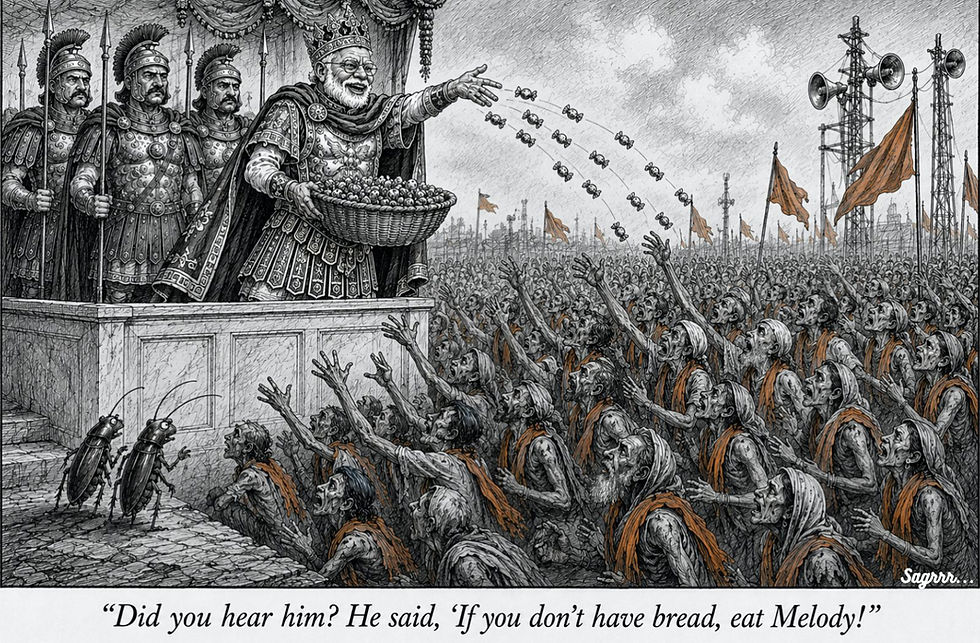
Starving peasants were just about surviving on bread: Her response? It signified the abject alienation of a debauched aristocracy and a bloated monarchy, while the people suffered. The quote, Qu'ils mangent de la brioche, was originally part of Jean-Jacques Rousseau’s book: Confessions (1765),
Now, the uncanny, creepy-crawly cockroach has entered the vocabulary of a spontaneous social media protest which is riding the wings of angst and anger. Clearly, the Hindutva-dictatorship in Delhi, is stunned.

Protest Politics in the Age of Alienation
These changing symbols reveal not only changing politics. They reflect the changing state of social consciousness, and the ‘subterranean stream of consciousness’ struggling to erupt in the suffocating and repressed atmospherics of contemporary India.
The Tea Party movement in the United States emerged during the economic turbulence following the 2008 financial crisis and the presidency of Barack Obama. His main slogan was, Yes, we can.
Obama signalled hope amidst all round despair. That is, after Right-wing Republican George Bush’s infamous ‘Blood for Oil’ war against Saddam Hussain in Iraq, chasing mythical Weapons of Mass Destruction (WMDs), even while a debilitating recession struck the US. Tens of thousands were killed in Iraq, in this manufactured ‘Clash of Civilisations’.

In the historic Boston Tea Party of 1770s, American colonists rebelled against British taxation. Tea became a metaphor for resistance against expanding State power, government spending, taxation, and the elite.
The movement drew support from conservative middle-class Americans, libertarians, and anti-establishment voters who believed Washington had become disconnected from ordinary citizens. Through rallies, media campaigns, and grassroots mobilisation, the Tea Party influenced the Republican Party. Public frustration still believed in organised, ideological confrontation.
Soon after came the Coffee Party, founded in 2010 by filmmaker-activist Annabel Park as a response to growing hostility in American political life. If tea symbolised rebellion, coffee symbolised dialogue.
Inspired partly by the European café culture — where writers, philosophers and reformers debated public issues — the Coffee Party imagined democracy as a space for listening rather than shouting (as in most of prime time stooge media in India). Its founders promoted civic participation, fact-based discourse, and political moderation. The movement never achieved the mass energy of the Tea Party.
Now, in the age of algorithms, confrontation has overtaken conversation.
Within India’s digital landscape, another pulsating symbol has appeared: the Cockroach Janata Party (CJP).

Stooge Media: Tyranny of Mediocrity
The Gen Z movement has taken social media by storm, hitting 18 million followers in less than a week, overtaking BJP’s alleged followers by an unprecedented margin. It’s X handle, predictably, has been blocked by this repressive regime, with panic written all over this diktat.
Will they now issue arrest warrants against the young founder of CJP? Or, all the male and female youngsters on Social Media, telling their stories?
The CJP is not a political party. It is a digital storm. It is still ambivalent, eclectic, fluid, amorphous. However, that does not take away its authenticity, lucidity, and originality.
It has emerged with sharp, spoofy spontaneous satire and robust, critical dissent, with angry, frustrated youngsters from across multiple backgrounds expressing themselves without fear, from metros to small towns. With a huge following of articulate and brilliant young women, splashing creative, catchy caricature and commentary across the social media, there seems to be an endless stream of anti-establishment discourse. Check out Instagram, for instance.
Given the abysmal state and the abject Tyranny of Mediocrity in the sold-out media, it is, indeed, a big relief. With thousands following them, these youngsters have become the new super-stars of the parallel media.
And the parallel media has become the mainstream media.

The Hated Cockroach: A Revealing Metaphor
History always takes you by surprise. Who would know that the chief justice’s remark would be turned into a dark, comic identity? This radical paradigm shift carries deep sociological meaning.
The cockroach is perhaps one of the most revealing metaphors of contemporary society. It is hated. It survives all kinds of hostile environments, even, allegedly, apocalyptic nuclear wars. It lives almost unseen, underground, inside hellish gutters, unhygienic crevices. The Netherworld. It is ugly, unwanted, nearly impossible to eliminate.
In reclaiming this image, our frustrated youngsters appear to express a painful, suppressed truth: modern systems treat ordinary citizens as disposable garbage, especially educated young people trapped between aspiration, alienation and stark unemployment. The umpteenth leak of NEET papers, affecting more than 22 lakh students, and the tragic suicide of 17 youngsters -- hurts.
Indeed, they might lack an ideology or coherent theory. However, beneath the outburst lies exhaustion. Crushed aspirations. The longing for hope. Justice. A genuine people’s democracy.
Mass joblessness, highest since decades, examination scandals, open corruption, nepotism and bribery, shrinking opportunities, and stark, rude indifference of the intoxicated powers that be – the spoofy ‘melody khao khud jaan jao’, and Work from Rome memes are a pointer.
The language of Gen Z carries no jargon or clichés, no ideological baggage or fake theory; it is loaded (and uploaded) with scathing, digital irony. Black humour has become a defence against humiliation. Fearlessness has replaced State terror.

At its heart lies the question of human dignity within systems of arrogant power. A civilisation that reduces forests and rivers into commodities, reduces human beings into banal statistics. The same structures of domination that exhaust the earth, and the nation-state, also exhaust the human spirit.
Hence, the rise of symbolic, spontaneous, digital protests, reflect this deeper crisis of disconnection.
The system cares a damn for ordinary folks, especially the young. Sensitive, aware youngsters are also concerned citizens. They are visible online, but invisible within the entrenched structures of the fake news, corporate media, and, the one-dimensional political establishment, especially in the current Banana Republic of India.
This is where the cockroach metaphor acquires disturbing power. It symbolises survival within a starkly cruel, cold-blooded and indifferent system.
Against all odds.

The Language of Emotions
History repeatedly shows that emotional symbols often emerge before spontaneous or organised movements. Even movements that have eventually failed.
The Cockroach Janata Party may or may not become an electoral/political force, but it reveals an essential truth: the young in India feel abjectly ignored, crushed and humiliated, and they are now refusing to take it lying down.
Tea represented rebellion. Coffee called for conversation. The Water Melon told the suffering of Gaza. The cockroach symbolises dogged endurance and stoic resilience. It is another form of Peaceful Satyagraha.
Charkha goes Digital.
In May’68, the students in Paris wrote graffiti on the wall: Give flowers to the rebels who failed!
Hence, at independentink.in we say:
Give one hundred flowers to the cockroaches who rebel. Let a hundred schools of thought bloom!

Amit Sengupta is Editor, independentink.in
Suresh Nautiyal is Contributing Editor, indpendentink.in
Barring the past photo, all photos courtesy Instagram