


The M Fort: The young have knocked off the front door

The cockroach movement has made possible what seemed impossible until a few days ago. The youth have not only knocked on the front door of the Modi fort, they have knocked it off! They have reclaimed India’s democracy.
By Subrat Kumar Sahu in Delhi
What did the Gen Z achieve, asked a friend. I said they not only burst the imaginary Modi bubble, they also reclaimed the space for dissent in quick time, something the Opposition could not do in 12 years.
Even though the Cockroach Janata Party’s demands were too small, the mass uprising it effected on the streets and in people’s consciousness – especially among the youth and the middle class – was astoundingly too big, historic, and unprecedented. Here are some observations.
The movement was pleasantly spontaneous, but people’s anger and frustration were not.
The anger and frustration was brewing for quite some time and suddenly found a long-overdue space to vent itself out. The youngsters created an open democratic platform on the streets and social media to express themselves with unimaginable freedom; a platform defiantly thrown open to the public by this historic students’ movement, which had its nerve centre at Jantar Mantar in Delhi, but had spread its content, impact and articulation all over the country. Across the globe it was distinctly noticed, including by the world media.
The most striking revelation was that people are extremely angry and frustrated with the Modi regime. Dharmendra Pradhan’s resignation may be the victory point of the CJP (and rightly so), but if you listen to what thousands of young people (and also older ones) genuinely express in videos captured during the protest, their utterly disdainful anger is squarely at Modi and the RSS-BJP ecosystem.
Not only the video bites, all the memes that are floating on the internet connected to the protest are targeted at Modi and RSS-BJP.
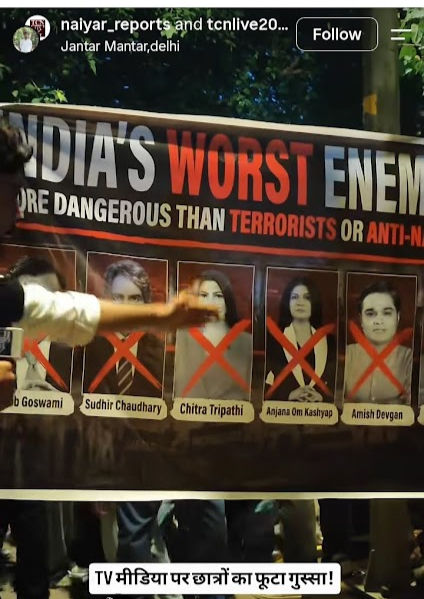
So, for record, the ‘M bubble’ is burst in Delhi, and in other cities and towns and small towns, and on social media as a full public spectacle – despite the Godi (lapdog) media and their factories of lies, security forces and their excesses, and the BJP IT cell and its propaganda machine.
The second loud and clear target of people’s anger and disdain were towards the Godi media (the ignominious big business media). In such an unprecedented political situation, first time since 2014, both ‘Modi and Godi’ looked frantically helpless. Both seemed clueless. Even the RSS did not know how to respond.
People loved and engaged with the independent,/alternative media teams and reporters, sending a stern warning to Godi media and their industrialist-BJP-RSS masters. Suddenly, the alternative media became mainstream. And I hope it stays that way, thanks to the roaches.
With the Cockroach Janata Party at the centre of the nucleus, other students’ groups/parties also constituted the strength of the movement. Several Ambedkarites, Left, Democratic, and other progressive students held together the momentum, broad-basing the political narrative and perspective beyond the primary demands.
Abhijit Dipke and leaders of the CJP and other students’ groups demonstrated a precious political lesson for larger political parties (especially the Opposition) on how to creatively use dissent and resistance without rhetoric, without falling apart, and without succumbing to the temptations of diverting from the central issue.
One step at a time was the winning strategy, which Gen Z appeared to have understood much better and clearer than weathered politicians and political analysts. Stay focussed on the goal, stay alert so as not to be burnt out before time, and stay careful that the platform does not crumble; others would any way bring in what they think are missing. And that is exactly what happened.
The stage was to call for the education minister’s resignation, but the ear-splitting bugle sounded by the people was entirely against the Modi regime and its misrule in all aspects.
Even though the rot in the education and examination systems were central to the movement, people on the streets fearlessly opined on every possible issue that they have been observing and worried about: RSS/BJP’s communal and casteist politics; India’s unconditional surrender to the US economic bullying; disempowering and misuse of autonomous public institutions, like the judiciary, CBI, ED, police, universities, etc.,; the collapse of the healthcare system; rising crimes against women; the petrol-ethanol conundrum; the criminal handing-over of India’s resources to Adani-Ambani; the Chinese aggression on borders; and the prolonged unconstitutional detention of scholars like Umar Khalid and Sharjeel Imam without trial!
People’s voices, concerns and anguish found a platform, finally. And that is what mattered the most.

It was given for sure that the cockroach revolution would not be televised by the sold-out media. So, it was thoroughly Instagrammed and Facebooked by alternative-media reporters and amateur reel-makers.
They ensured that those who were not physically part of the protest were also informed. Because, the anger is widespread and not everyone can join a protest. Those who could not, thereby, also felt involved, and their voices heard.
The CJP is not a political party in the conventional sense. At best, it is an informal Collective of young minds, with dreams and visions.
The fact that well-established students’ groups – Left, Ambedkarite, Democratic and other progressives – readily joined under the leadership of a new Collective, showed political maturity and farsightedness by the young generation. They have read the political atmosphere well.
Even a higher level of political maturity, context-reading ability, and road-mapping for future politics lies in the comfortable acceptance of a young Dalit as the leader. This was a significant statement that has positive implications for the future.
Prior to this movement, Abhijit Dipke, who ignited the fire with a social-media post from Boston with the wishful idea of forming a party of cockroaches – had to face casteist and racist trolling online. The cockroaches proved to be humane, intelligent, wise, unprejudiced, and responsible. They know they are the future.
Abhijit was clearly visible at the helm. That was another factor that frustrated the Modi regime and its bigoted followers: that a movement led by a young Dalit scholar was shaking the regime.
The youth were complete in themselves. A large cut-out of Anitha – the first protester against the NEET system and the first victim too – was on the stage; nothing could have been a better political statement and stronger rallying point.
Indeed, Opposition parties not trying to override the youth movement, while supporting their cause from the side-lines, was a sensible act.

The posters, the memes, the Insta videos, the tiny bites to reporters, the slogans, the conversations, the speeches, the carefree articulation, the damning accusations, the promising smiles, the confident eyes: all this exhibited all that India is suffering from. It is this wide-ranging content on display that made this protest unique, effective, historic, and worth learning from.
Despite the unauthenticated claim that the CJP was ‘apolitical’, what the movement provided was an expansive ‘political space’ for inclusive and combined resistance against tyranny and political banality that is destroying India. And everyone united with the chant of Jai Bhim… Jai Bhim (praise for Dr Bhim Rao Ambedkar). That is another constructive statement by the youth that has positive implications for the future.
For the past 12 years, such a thing was beyond imagination. Millions spent in building the ‘infallible’ image of Modi was washed away in a wink by the July uprising.
What opposition parties could not do over the years, Gen Z could do in just a few days. The cockroach movement has made possible what seemed impossible until a few days ago. They have rekindled hope. Reclaimed India’s democracy.
The youth have not only knocked on the front door of the Modi fort, they have knocked it off. What follows next depends on how collectively and cohesively this momentum is taken forward, and with all the strategic lessons learnt from this magnificent summer uprising of 2026.
Subrat Kumar Sahu is an independent filmmaker and journalist, based out of New Delhi..
Photos courtesy Instagram