


Dangerous Sex, Invisible Labour

Over the past 10 years or so, many of these forms of work have been abolished by the government, whether it's bar dancing, or imposing bans on erotic dancing etc, or legal restrictions on commercial surrogacy. And when it comes to paid domestic work, there's very little that's done for the domestic workers from a policy or legal perspective.
By Baishali Chatterjee
The laws of Social Reproduction is an interdisciplinary project, hosted by King’s College, London, to re-theorise the normative, empirical, regulatory and political dimensions of social reproduction in India across five fieldwork sections: unpaid domestic and care work, paid domestic work, surrogacy and egg donation, erotic dancing, and sex work. The project, for a period of three years uses social reproduction as a prism to study women’s reproductive labour to produce insights into certain ‘contested’ fields of work.
Drawing on feminist legal theory and deploying methodologies ranging from doctrinal case law analysis to ethnographies of women’s labour markets, the project problematises law’s jurisdictional boundaries over women’s reproductive labour and critiques the varied, even contradictory, legal regulation of reproductive labour as well as the misguided law reform initiatives that undermine women’s economic agency.
In a two-part series, Baishali Chatterjee will be in conversation with academician Prabha Kotiswaran, a faculty at King’s College London, and also the Principal Investigator of the project, and Mumbai-based filmmaker Paromita Vohra on the different dimensions of the Laws of Social Reproduction project.
Professor Prabha Kotiswaran is Professor of Law and Social Justice at the King’s College, London, Dickson Poon School of Law. Her main areas of research include criminal law, transnational criminal law, feminist legal studies and sociology of law. She is the author of Dangerous Sex, Invisible Labor: Sex Work and the Law in India, published by Princeton University Press (2011) and co-published by Oxford University Press, India (2011),
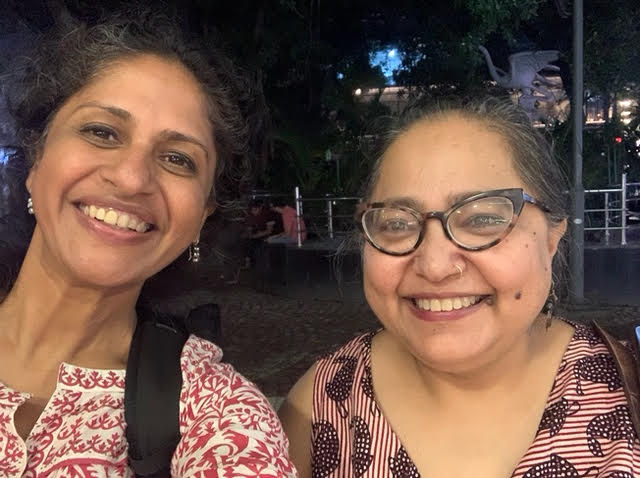
Baishali: Prabha, the introduction to the Laws of Social Reproduction would be a good way to start this conversation. Can you please share about how the project was conceived?
Prabha: I think a lot of the initial ideas of the project really took off from the concept of social reproduction because when I was studying sex work for writing my first book (Dangerous Sex, Invisible Labor: Sex Work and the Law in India), the idea was to think of it as a form of labour, which is what the sex workers’ movement was arguing for. But the theory behind the mobilization wasn't really there, because I think no matter which stream of feminism it was other than the sex positive feminists, most feminists were thinking of it as definitely anything but work.
So, I think the initial idea behind the project was to talk about a materialist feminist approach to sex work to see how we can improve the economic rights of sex workers. And in a certain sense, the project is an expansion of that idea to look at different forms of women's work, which may or may not be considered as ‘work’, but to place them along a kind of continuum of reproductive labour that's performed within the home, without pay, out of ‘love and affection’, but at the same time to recognize them as labour that's performed for the market.
While I was doing the research on sex work, the bar dancing ban came about in Mumbai, and this brought to the fore the role of law in deciding what was work and what was not. The Bombay High Court judgment said very clearly that sex work and dancing are two different things which put dancing in the realm of commercial activity, but sex work was not a commercial activity.

In 2012, I visited Anand, the center of commercial surrogacy in India at that time and had interviewed doctors. I found a lot of similarities between these forms of work. And over time, over the past 10 years or so, many of these forms of work have been abolished by the Indian government, whether it's bar dancing, or imposing bans on erotic dancing etc, or legal restrictions have been put in place, such as in this case of commercial surrogacy.
And when it comes to paid domestic work, there's very little that's done for the domestic workers from a policy or legal perspective. So, I just thought that from a legal perspective, it was interesting because the law produces categories, by making these forms of labour invisible or illegal rather than recognizing them as legitimate work. So, there was an impetus to break down some of those silos and have them along a continuum to see what the similarities between these forms of work are and how can we think of them as ‘work’.
I wanted to study these different forms of work with a view to improving women's economic bargaining power so that they decide when they want to do this kind of work, on what terms, for how long, can move on to do something else or stay within it. That’s basically the idea behind the project.
Similarly on dancing, we initially wanted to study bar dancing, but during COVID we couldn't really find it, but we stumbled on this form of erotic dancing in Tamil Nadu. So, we included that in our research.
Similarly, on the issues of surrogacy and egg donation, leading up to the ban on commercial surrogacy, we had spoken to a lot of MPs. We had written about how bad the proposed laws were. And after the laws were passed, we tried to look at the impact of the law on what were doctors doing, and what were the women doing.
So, in our research project, we've got an empirical thread and then we have a legal analysis. It's the same approach with the domestic workers and with on unpaid work. With unpaid work, we've been looking at all the family laws around women's work, especially at the time of divorce and at the time of death. For example, we're looking at the motor vehicles cases to see how women's unpaid work is recognized as an occupation in the judgements. Our hope is really to make the public aware of some of these intricacies of how women's work is perceived.

Baishali: In Paromita's film, I was struck by how the issue of legality surrounding women's work is often deeply intertwined with moral judgments—particularly the way certain types of work are categorized as ‘appropriate’ and 'inappropriate' for 'good' women. This creates a complex legal-moral dichotomy. Is this tension something you consciously sought to address in your project?"
Prabha: It's morality which is the excuse for prohibiting certain kinds of work. But, all along, I think the patriarchal interests are very focused on extracting women's reproductive labour and it operates like a double play by saying that a commercial surrogate is a bad woman. By saying such things you're actually very cleverly appropriating her labour.
Under the law we are telling her that she should be doing it altruistically so that she does her best as a mother. But when she tries to bargain for more money because she herself is a mother, and wants the money from surrogacy to take care of her children, then she's told, that she’s being very cunning, and that she’s not like a mother, actually, but a greedy person. This interplay between how you should be and what you should not be is something that enhances the way labour is appropriated by society, all the while making such labour completely invisible. Because then you're thinking that this is something that you do for your family, and therefore what's the big deal if you do it for someone else and give them a gift of life and so on?
So, this is how women's labour is appropriated, and morality is a big part of it. But it's done not just because somebody has a certain moralistic posture, or because it's a dominant moralistic narrative, but also because certain key material interests are being served by using morality.

Baishali: The other thing I was thinking about was extending the connection to the Asha workers and what you were saying about the State appropriating women's labour. And, you know, obviously they wouldn't really find men volunteering their time vis-a-vis women who are seen as ‘carers and nurturers’. So again, I think that's kind of completed the circle in terms of women not only in the private space, but also in the public space -- in the way the State is usurping women's labour. But, it’s also a fact that these different forms of work exist in silos. Do you see any opportunities in bringing the women in these different forms of work together?
Prabha: It’s challenging but yes, it can happen. In the case of the dancers, or, certainly, sex workers or even the paid domestic workers, it's possible to produce a kind of an enabling legal environment that helps them negotiate with the people that they work for. Once that is secured, once they get what they want, such as a certain basic pay, rest days every month -- if there is some way in which they can get that -- and then their consciousness shifts towards seeing themselves as workers primarily then, that might also produce kind of shifts in how they mobilise, more as a collective rather than individually.
Baishali: What are your thoughts on the emerging trend of domestic workers entering the gig economy, especially through platforms? Is this something you've considered in your research, and do you see any significant implications arising from this shift?
Prabha: It wasn't part of the research explicitly because a very large percentage of domestic workers are not actually on these platforms, and we were actually keen to expand our research to small towns and understand what it looks like in non-metros. However, I do think that the idea of this platform can have potential as worker-friendly. And there are examples of this, right?
In Goa, the cab drivers have their own app. In Bangalore, the auto drivers have Namma Yatri. So I think there is a role here for technology to play. Especially where we can’t formalize by having standard contracts between an employer and a domestic worker, maybe you can have platform-based work that builds on this contract through the ‘I agree’ sign-in and so there are opportunities to reimagine using technology in ways that are actually worker-friendly.
What we realized through our research is that domestic workers care much more about pay, about working hours, days off, medical contingencies, and those are the kinds of things that hopefully we can prioritize via an app and see how best women can have access to those.

Dr Prabha Kotiswaran is Professor of Law and Social Justice, The Dickson Poon School of Law, King's College London WC2R 2LS. Her recent publications are A Right to Care, A Right to Welfare: A Study of the Kalaignar Mahalir Urimai Thittam, Valuing Care, Recognising Rights, Reimagining Welfare: How to Make Unconditional Cash Transfers Gender Transformative, Women’s Work Never Done Now Paid Assessing Tamil Nadu’s Urimai Thogai Scheme, Justice within the New Factory Gates: How to hold RWAs responsible for workers' welfare, Legal (Dis)Orders: A Feminist Assessment of India’s Assisted Reproductive Technology and Surrogacy Laws, Reproductive resistance, law, and informality: a critique of the Indian Assisted Reproductive Technology (Regulation) Act, 2021
Baishali Chatterjee is a senior development worker with over 20 years of experience advancing gender justice across the Global South. She has led transformative programmes on gender equality, SGBV, climate and gender, and women’s economic justice. She holds a postgraduate degree in social work from the Tata Institute of Social Sciences. She's currently based in Bangalore.
Photos courtesy Dr Prabha Kotiswaran.