


Ankita Bhandari Murder Case: The lingering shadow of injustice

The case exposed the entrenched nexus of power, business, big money, and political patronage, especially in tourism-driven regions. And it became symbolic of all that is rotten in our society.
By Suresh Nautiyal Greenananda
Some cases simply refuse to fade.
Not because they remain unresolved in law, but because they remain unsettled in the moral life of a society.
The murder of Ankita Bhandari, a 19-year-old working woman from Garhwal in Uttarakhand, is one such case.
More than three years after her death, and even after convictions by a trial court, Ankita’s name continues to return, again and again—through grief. Through protests. Through controversies.
And the lingering shadows of injustice in the face of powerful men, allegedly belonging to the ruling regime in the state and in Delhi.
This persistence is not accidental. It reflects a deeper public discomfort. A sense that justice, though pronounced, has not fully healed the simmering wounds, nor restored confidence in institutions meant to protect the citizens.
Especially women.
Especially the vulnerable.
The Sequence of Crime
On 18 September 2022, Ankita Bhandari went missing.
She was employed as a receptionist by Vanantra Resort, a riverside retreat located in Ganga Bhogpur Talla area in Yamkeshwar block of district Garhwal, near Rajaji National Park in Uttarakhand.
In the days preceding her disappearance, she had conveyed distress to close contacts, alleging pressure at her workplace to provide ‘special services’ to a so-called VIP guest. WhatsApp chats later cited in the court proceedings, and reported by The Indian Express, revealed her anxiety and resistance—most hauntingly in a message where she wrote, “I am poor, but will I sell myself for Rs 10,000?”
This sentence exposed not only personal fear, but the coercive character of informal workplaces, where power, influence and wealth, politically connected in most cases, operates without accountability.
Six days later, on 24 September 2022, Ankita’s body was recovered from the Chilla Canal near Rishikesh. The circumstances clearly pointed to foul play, and a murder case was registered.
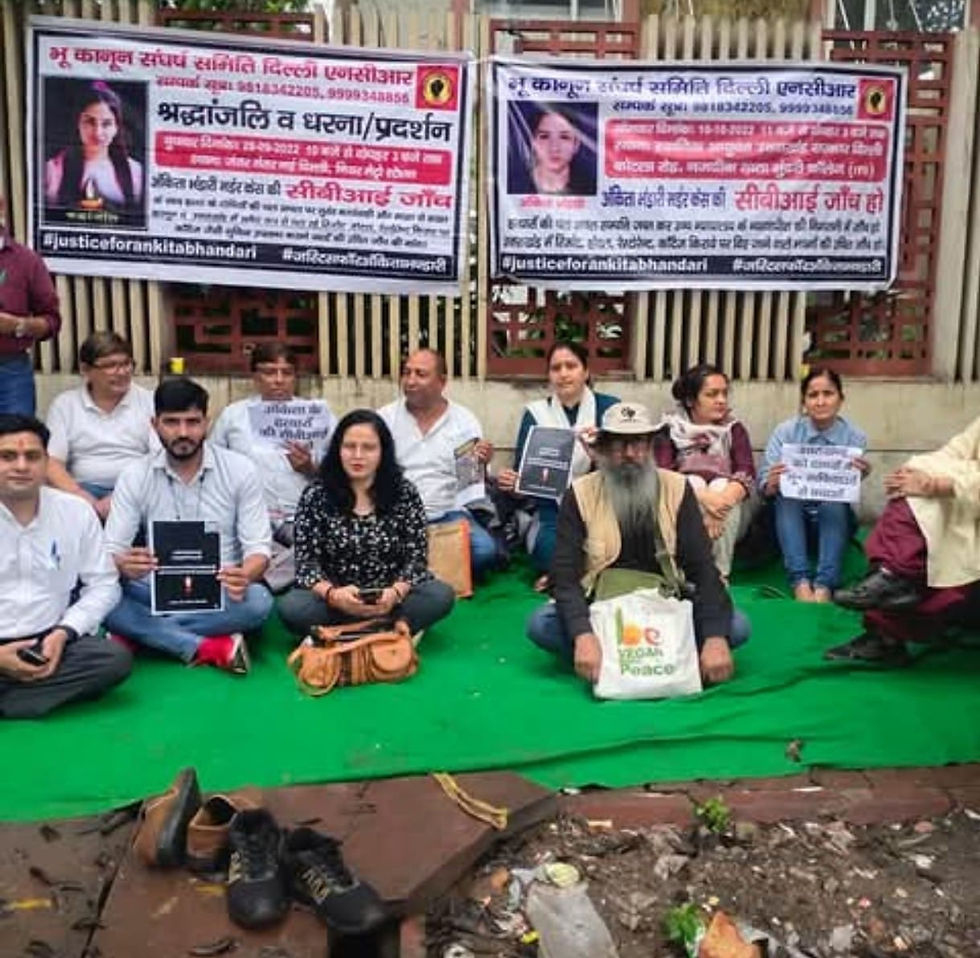
What followed was not quiet mourning, but a massive wave of public anger and protests across Uttarakhand and beyond—including in Delhi-NCR, and rest of the nation. Her murder, the murder of a young girl trying to earn her living, shook the soul of the nation. It became symbolic of all that is so transparently rotten in contemporary society.
Protesters blocked highways, burnt effigies, walked the streets, and carried banners reading ‘Justice for Ankita,’ accusing authorities of delay, intimidation, and political shielding.

The outrage was amplified by one uncomfortable fact. The resort owner, Pulkit Arya, belonged to a politically influential family aligned with the ruling Bharatiya Janata Party (BJP). Almost immediately, the case ceased to be viewed merely as a crime; it became a test of political credibility.
Under mounting pressure, the Uttarakhand state government constituted a Special Investigation Team (SIT). While this move was projected as evidence of administrative seriousness, scepticism persisted on the ground. Many asked whether the SIT was an act of political will—or a response forced by public fury that could no longer be contained.
Criminal Trial
The criminal trial formally began on 28 March 2023 in the Additional District and Sessions Court, Kotdwara, in the state. The SIT filed a voluminous chargesheet running over 500 pages, supported by statements from nearly 100 witnesses.
The prosecution relied on circumstantial and digital evidence: Mobile location data, electronic chats, alleged CCTV tampering, and testimony pointing to pressure exerted on Ankita regarding ‘special services’. The defence highlighted the absence of direct eyewitnesses; the prosecution maintained that the evidentiary chain was complete.
Throughout the proceedings, Ankita’s family refused to allow the case to dissolve into procedural routine. Journalists such as Ashutosh Negi sustained public attention through persistent reporting from the hill districts, while public interest advocates pressed the prosecution to pursue the case without dilution. Civil society groups framed the case as emblematic of deeper structural failures—women’s rights and safety, workplace exploitation, and uneven policing standards in smaller states.
Initially, Advocate Jitendra Rawat was appointed as the Special Public Prosecutor. However, his tenure was short-lived as Ankita’s parents demanded his removal in mid-2023, alleging he was sabotaging the case.
Following his recusal in July 2023, the state government appointed Advocate Avnish Negi as the new Special Public Prosecutor to lead the trial. Simultaneously, the family sought a more rigorous investigation through the higher courts, with Advocate Pushpa Joshi representing them in the Uttarakhand High Court and Senior Advocate Colin Gonsalves arguing for a CBI inquiry before the Supreme Court.
Throughout the proceedings, the family was also supported by Advocate Ajay Pant in the local courts and Ashutosh Negi, who filed critical petitions on their behalf. This collective legal effort culminated on May 30, 2025, when the Kotdwara sessions court finally sentenced Pulkit Arya and his accomplices to life imprisonment for the murder of Ankita Bhandari.

Conviction
After more than two years of hearings, on 30 May 2025, the Kotdwara court convicted Pulkit Arya, Saurabh Bhaskar, and Ankit Gupta, sentencing all three to life imprisonment under multiple provisions, including murder (IPC Section 302) and destruction of evidence.
Across Uttarakhand, after the protracted and peaceful struggle, the verdict was widely perceived as hard-won, though long delayed. Yet, few described it as a victory. Many felt the punishment fell short of public aspiration, as calls for capital punishment had echoed loudly.
Politically, the convictions offered temporary relief to the BJP government, enabling it to argue that the judicial process had functioned independently. However, the damage to the image of the party, in public perception, had already been done.
For many citizens—especially women, students and young activists —the case reinforced a troubling belief: justice moves swiftly only when public outrage becomes impossible to ignore. The lingering question remained—had the accused not been politically connected, and the protests so widespread, would the system have responded with the same urgency?
Moral Outrage
Consequently, indeed, predictably, the verdict still did not convince the public. Candlelight marches and demonstrations continued in several districts of Uttarakhand, demanding not only punishment for the criminals, but accountability from systems that allow exploitation to thrive.
Opposition parties—including the Congress, Uttarakhand Kranti Dal, CPI-ML-Liberation, India Greens Party, and Uttarakhand Parivartan Party—sought to channel this sentiment into political mobilisation. While none could claim ownership of the movement, the case undeniably provided moral ground to challenge the ruling party’s claims of clean governance and women’s safety.
Whether this moral anger will translate into long-term electoral consequences remains uncertain. Uttarakhand’s political history suggests that public outrage does not always convert neatly into votes. Yet, the Ankita Bhandari murder case has undeniably eroded trust—particularly among women, youth, and hill communities—creating a moral deficit that no slogan or campaign can easily repair.

Appeal in High Court
Fast forward. The convicted men appealed in the Uttarakhand High Court, which scheduled final hearings for 17 November 2025. The defence reiterated arguments regarding the lack of direct evidence, while the prosecution emphasised forensic and digital trails. As of now, the High Court has not delivered its final judgement. The trial court’s conviction stands, but remains under judicial review.
Ankita’s family also demanded a CBI investigation, citing a lack of confidence in local policing—a plea the High Court rejected. Public interest petitions used the case to highlight systemic weaknesses in handling missing-person complaints involving young working women.
New Public Discourse
Now, in December 2025, the case re-entered public discourse through viral social media allegations naming certain prominent political figures in the hill-state.
The Telegraph, in a report dated 28 December 2025, carried allegations by television actress Urmila Sanawar, who claimed that senior BJP leader Dushyant Kumar Gautam was the mysterious ‘VIP’ linked to the case. Gautam denied the allegations and threatened defamation action.
The same report quoted Sanawar alleging exploitation by another BJP leader and naming several politicians—referred to as “Gattu, Bhattu and Fattu”—as figures who allegedly preyed on women employees at the resort.
Protests started erupting again on the streets, against the BJP politicians.

FIRs followed, denials were issued, and police warned against misinformation. Once again, a familiar cycle unfolded. The process of law proceeded cautiously, politicians reacted defensively, and public trust started thinning further.
So, what stands decided is the trial court’s conviction and life sentences. What remains pending is judicial scrutiny by the High Court. And, what remains unresolved is deeper -- the question of political and institutional accountability.
In this context, inquisitive minds are asking whether there was an absence of political will in the early days, or merely administrative inertia?
Did proximity to power delay decisive action, or did public perception outrun the facts?
These questions persist not because the courts failed, but because governance is judged not only by verdicts, but by timeliness, transparency, and moral clarity.
Ultimately, Ankita Bhandari’s death has become a symbol of the risks faced by working women in environments governed by influential men with connections, informal authority, fragile protections, and unsafe dignity. It illustrates how swiftly justice becomes politicised—and how easily truth is buried beneath suspicion.
In the hills, silence is often revered as wisdom. But in matters of injustice, silence turns into complicity.
Ankita’s case reminds us that justice is not only about punishment after death—it is about protection before harm.

Crime scene demolished. Why?
The reported failure of the police in the Ankita Bhandari murder case was not accidental but procedural, ethical, and institutional. When Ankita was reported missing, the response lacked urgency, and the crucial early hours passed without explanation. What should have been an emergency was treated as routine, pointing to grave negligence or deliberate delay.
This failure deepened with the demolition of the Vanantra Resort, the primary crime scene. Why did they do that?
The fact is, regardless of administrative justifications, destroying the site before completing forensic processes, irreparably harmed evidence and public trust. A crime scene embodies truth, and in public perception, its destruction suggested that administrative power had overridden justice.
It was so clear: political pressure loomed large.
The accused’s political connections appeared to shape police conduct, making it hesitant and reactive. Alleged transfers, tacit silence, and opaque communication reinforced perceptions of compromised autonomy.
Though arrests followed, delayed and diluted justice cannot be called genuine. Responsibility lies with individual officers, senior police leadership, and the Home Department, which, as is widely believed, allegedly failed to shield law enforcement from influence.
Elected representatives also failed Ankita. Most spoke only after public outrage grew, prioritising party loyalty over truth. Political leaders were largely absent on the ground, leaving Ankita’s family dependent on civil society. Local MLAs, MPs, and ministers failed to intervene decisively, largely choosing detachment over conscience.

At the institutional level, the ruling party’s response was systemic failure. The BJP government’s primary instinct seemed containment, not accountability.
Image management came before truth, and ethical action followed only under pressure. The case exposed the nexus of power, business, and political patronage, especially in tourism-driven regions.
Ankita lost her life, and for a moment, the State lost its moral authority—something that can be restored only through reform, humility, ethical conduct, clean and conscientious politics, and the courage to place justice for the ordinary citizen over and above the dynamics and compromises of power.
In a nutshell, until workplaces become safer, institutions more transparent, and power more accountable, Ankita Bhandari’s name will continue to return—not as history, but as a warning. And warnings, when ignored for too long, have a way of returning with greater force.

Suresh Nautiyal Greenananda is an independent journalist, rights activist and green politician based in Pauri, Uttarakhand and Delhi.